The Zombie Autopilot Pipeline

The Zombie Autopilot Pipeline

A bit of backstory for you.  

This post chronicles the journey I went through to convince a couple of skeptics (my family) that Infusionsoft’s Sales Pipeline Component isn’t an unreasonable, hunk of junk, waste of time.

Let me tell you what I did wrong when creating a Sales Pipeline for my family business. Yeah, egg on my face. I’m putting this out into the world so you dear reader, don’t get any egg on yours.

And then what I did right.  Read this, and it won’t matter if you’re building pipelines for your own business or for your clients, you’ll be able to do it right from the start.

————————–

I learned Infusionsoft four-ish years ago by implementing apps and campaigns on our new-at-the-time family remodeling business.

My mom and husband are owners, and they were my test subjects. I start here because there’s a different dynamic to implementing new technology when your co-workers are your family. Grumbling about change is a little more pronounced when you’re related by blood or a vow. Understatement of the year?

The Sales Pipeline feature in Infusionsoft is wonderful when you have a situation where you are having one-on-one sales conversations with prospects. Typically, these are higher ticket items that require a longer sales process. Home remodeling = Perfect Fit. Lots of 1:1 conversations. High-ticket items. Long sales cycles. By definition, it’s the perfect tool. (Editor’s note: And if you may need more than one pipeline, no problem. Read more here.)

Now, here’s the beginning of how things went wrong for me.

In my attempt to get the team all aboard the Sales Pipeline Express, I originally built a Pipeline that would make your grandma say “hot damn!”. (Sounding good so far, right?)

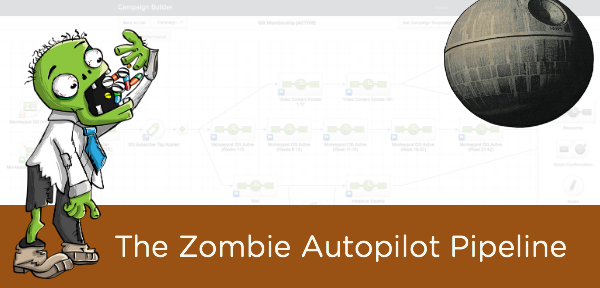
I spent days and days creating this masterpiece of a campaign. Circa 2015, it most likely took this form:  Zombie Pipeline for Infusionsoft screenshot
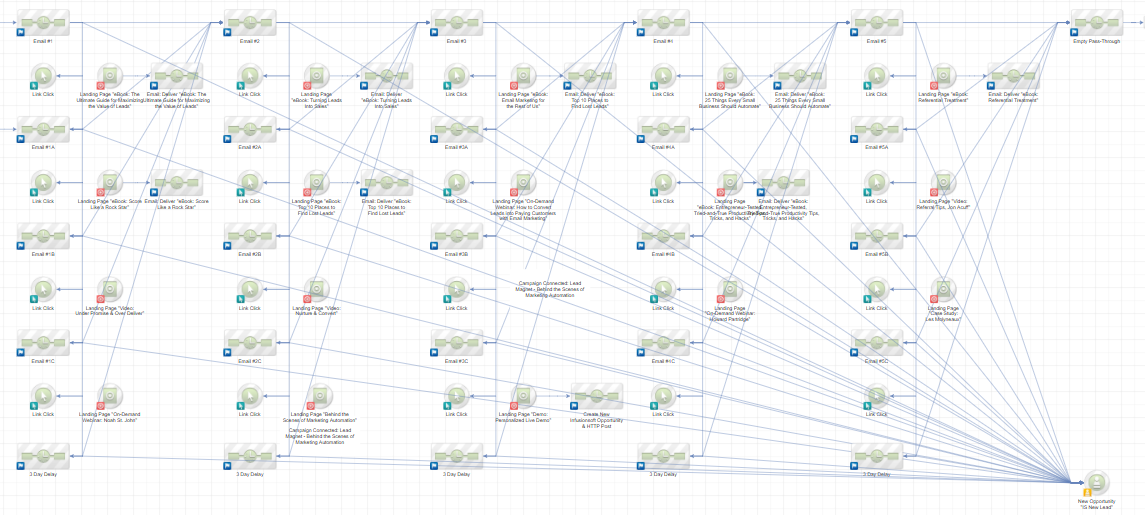
Family Drama. (Tragedy of tragedies).

Even after the explainer videos, SOPs, and daily walk-throughs, the team did not seem to “appreciate” the beauty that was this pipeline. They did not “appreciate” my genius.

The team’s stages of emotion went as follows: Excitement → Overwhelm → Frustration → Fury → Abandonment → Mutiny.

I was mad. They were mad. Horror of horrors.

Husband and Mom said to me “Yea. Infusionsoft is never going to work. Turn it all off.” It was the abject failure of what I’d hoped to achieve. A painful and bitter defeat, as you can imagine.

Has this ever happened to you? Overwhelmed with the depth of possibilities of Infusionsoft – the eject button starts to look more and more appealing, you, your staff, the client, everyone just wants out? So much so, that they give up on a masterpiece of a campaign you’re created. Whether it has or hasn’t happened, I’m hoping this post will help you prevent it entirely.

After this epic fail, a new adventure turned up for me professionally.

New Year. Who dis?

In January 2017, I left Infusionsoft to work in the family business full-time(ish).

I ramped up social and traffic on the inter-webs. Of course, this meant that there were more consultation appointments, and it was difficult for the team to manage the follow-ups manually.

I enjoy sarcasm and fighting with my family (exasperation can be fun, no?), so I decided to give the Sales Pipeline integration another shot with a different approach. So this is what I did.

Ready for Home Makeover Pipeline 2.0?
Sales Pipeline screenshot

Tah-Dah!  Presto!  Voila!

With this new, improved Sales Pipeline campaign, team buy-in increased 200%. Daily usage of Infusionsoft increased 600%. Hearts were healed. The pope kissed my ring.

“But Reyna – Where is the pipeline? What converted the skeptics? I don’t get it. You’re weird.”

Husssshhh.
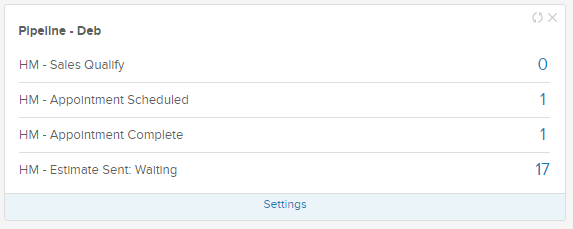
Pipeline

The Catalyst.

The change in team member adoption had nothing to do with a campaign.

It had everything to do with

  • Access to real-time reports
  • Instant opportunity organization
  • Easy access via Infusionsoft Mobile

Make Infusionsoft Feel Like Home.

As an Infusionsoft implementer, we tend to think we know what the world needs when it comes to a Pipeline.

We know the value that a ladder pipeline offers over a linear one. But even so, inevitably, we’ll miss.

On day one, people want to feel like they’re still in their comfort zone, even though they’re in a new system. Whether it’s your clients or your in-house sales team, they want to feel like they still have control.

“But Reyna – Sales Pipeline can do so much more. This is beneath me.”

Sure! Version 4/Death Star in a few months will look different. But I’m telling you – START HERE.

I lovingly refer to Version 1 of Sales Pipeline as “Zombie Autopilot Phase”

Zombie Autopilot Workflow Instructions:

One: Add the Opportunity name inside of Infusionsoft Mobile. No notes. No dates. No fluff.
Two: Change the opportunity stage when needed inside of Infusionsoft Mobile.
Three: Rinse and repeat.
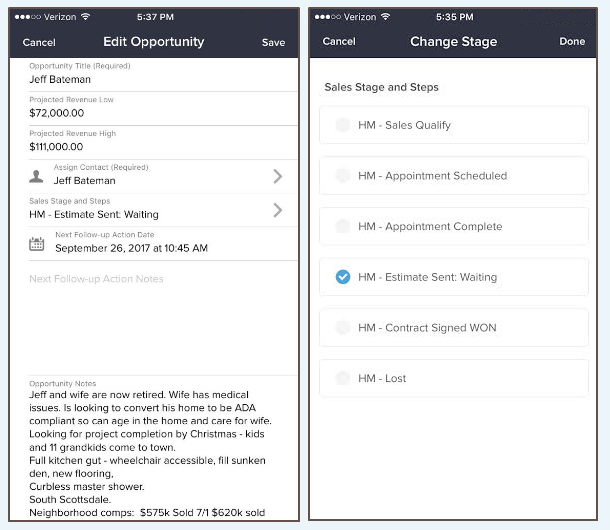
I dare you – deploy Sales Pipeline for two weeks exclusively via Zombie Autopilot Phase to your team.

As soon as the dashboard reporting starts reflecting and helping out with their Opportunity organization, they are grateful.

Grateful that Sales Pipeline is 1. easy. 2. helpful. 3. does exactly what they expect it to do (sans surprises).

The Flip.

Now,  I’ll tell you what’s kinda surprising. Suddenly, unprompted by you, people start asking Infusionsoft to do a little more. Take notes. Send a reminder email. Forecast revenue.

See that psychological flip? The asking part? The transfer of ownership? #money

20/20

Looking back, the cause of the mutiny after I released the original Death Star campaign was not a group of people excited to start a fight with each other.

It was ME.

I was big-headed and conceited. I was too excited to show off my fancy new automation.

So if you want to build a Sales Pipeline for a reluctant client (or reluctant sales team) – follow these steps:

  1. Build 4-8 oversimplified stages. (Read More)
  2. Put the done-for-you pipeline widget on the dashboard for your users. (Read More)
  3. Create Opportunity Records or your most serious prospects. (Read More)
  4. Use Infusionsoft Mobile to keep opportunities updated.
  5. Resist the urge to create an over-complicated Death Star Campaign.

Because it’s not about the campaign.

Lessons Learned

By not focusing on a fancy feast campaign, here are some positives that came out of Zombie Autopilot Sales Pipeline deployment.

Instant Gratification. It takes less than 15 minutes to build something like this and put it in your client’s hands. Wow moment? Yep! Great time to ask for a review? Yep!

Confidence Boost. Clients understand Sales Pipeline right away. They feel smart. Especially if they’ve heard negative things about Sales Pipeline before.

No Desktop Login. Infusionsoft Mobile is so ridiculously simple for managing the day-to-day in Sales Pipeline. Ever have clients that spend time outside of the office, on-site? Ever had a client get overwhelmed the second they log in to Infusionsoft? Yep. Mobile avoids that.

Proof of Concept. One of the harder parts of Sales Pipeline is learning to operate it and the concept of moving an Opportunity around. By focusing just on Opportunity movement first, clients are sold quickly.

Transfer of Ownership. As soon as I stopped begging the team to care about using Sales Pipeline, and I showed them the results, they stepped up and asked for more features. This is what we want in a client relationship, right?

In summary, QTMB&KISS – Quit The Monkey Business and Keep It Simple, Stupid. You’ll win the appreciation of your clients, staff, or anyone else who needs a pipeline that way.

Note: Remember that in order to utilize Opportunities you’ll need to have a version of the software that includes this module. If you don’t have it currently, you can upgrade to add it.

Bio: Reyna Bovee is a former Partner Trainer at Infusionsoft, and now works full-time leading business development and marketing in a family business she helped start. In her role at Infusionsoft she created content that helps elevate Partners’ businesses by adding Infusionsoft as an additional revenue stream.

For the past four years, Reyna has been driving her family business’ growth through the use of Infusionsoft. She lives and breathes small business every day, and understands the challenges and triumphs that come with owning and running a business.
Turning Any Link Into An Unsubscribe Link

Turning Any Link Into An Unsubscribe Link

Hey there Monkey Podders!

It’s your (arguably biased) favorite guest author back with another blog post that has some ground level technical wizardry in it.

I’m going to show you something I’ve been personally using for years in my own newsletter that is really easy to do once you understand what is going on. First, before we get into that, I have to share with you what problem we are solving for in the first place…

Infusionsoft Unsubscribe Links

Email subscriptions have gone though several evolutions since I’ve been using Infusionsoft. The legacy unsubscribe links were very powerful, but not well documented and susceptible to abuse. What I mean by “abuse” is that people were using a hack on subscription (confirmation) links to redirect and omit the confirmation message. In essence, they were tricking people into confirming their email addresses. This is an Acceptable Use Policy no-no. Unfortunately, the same “engine” was used on both link types.

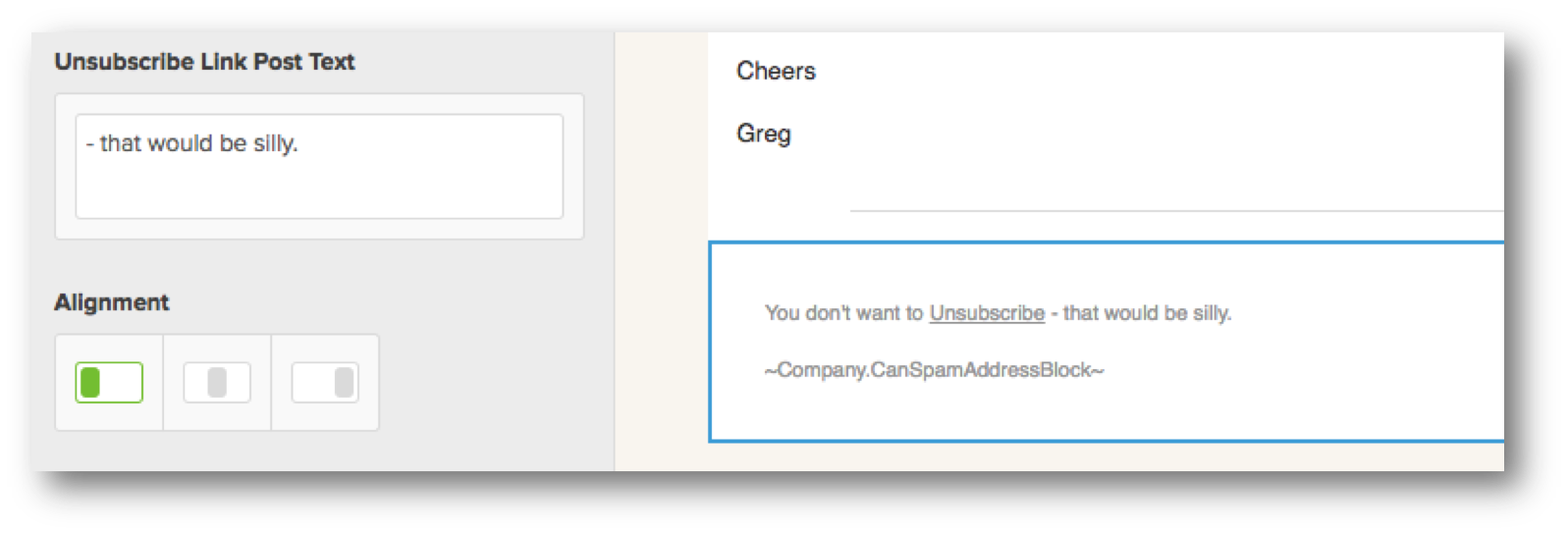
As a result, when unsubscribes were introduced into Campaign Builder, the functionality was severely limited because confirmations were severely limited. They have opened up the restrictions a bit lately. Specifically, you have more control over text before/after the unsubscribe link as well as the link text itself. You also have justification options (right, left, center).

Unsubscribe Footer

Definitely a massive improvement for the kinds of automated experiences you can create.

So what’s the problem?

Even if you use the ~OptOut_xx~ merge field hack, you are still limited to a text-based link only that stands by itself.

But what if you want to use an image to entice people to opt out? Or what if you want to embed an unsubscribe link within the middle of a sentence, like I do in my newsletters?

Until this moment in the blog post (technically further down), you would be out of luck.

Not today! I’m going to show you how to turn any link anywhere into an unsubscribe link 🙂

First, you have to make an unsubscribe link and send yourself an email containing it. You’ll see why later.

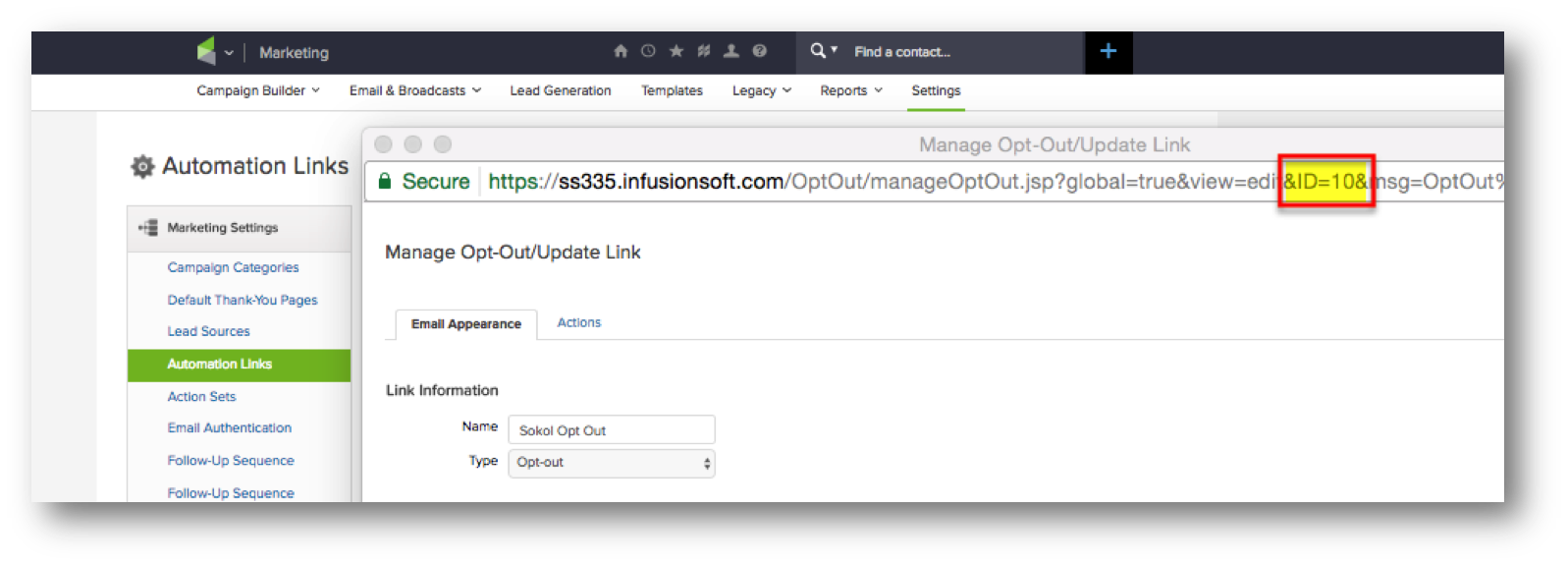
To do this, we start by going into our Marketing > Settings and go to Automation Links. From there we can add a new unsubscribe link. All you need to do is give it a name, some placeholder link text, and Save (not Save & Close).

When the page reloads, pay attention to the ID in the URL. We are going to need this.

Opt Out ID

Now, go into any email and put in the merge field ~OptOut_xx~ where “xx” is the ID we just obtained; you’ll know you did it right if you see the link text in your preview.

Now send that email to yourself. Here’s where we get really under the hood.

Hover over the link in your browser and right click on it. Copy the link location and bring it into a Notepad. Paste it into your notepad.

By now, you should have a link that looks like this:

https://voyicks.infusionsoft.com/app/optOut/25/70b25da2de31f7b1/40162/4a871468d7b3ed95

You may notice something, our link ID is in that URL right after the “/optOut”. I noticed that too. I also noticed that that random hash string of characters (in this example asfasdf), was the same for every opt out link in every email each time. That got me thinking, there has to be a way to manually construct a link with the same structure!

Knowing how the system works, I also observed that the number after the random hash string was an Infusionsoft batch/email ID. Then I remembered: we have a secret merge field for the batch ID (and the other one)!

I discovered these one afternoon many moons ago when I converted an email with the social sharing widgets (remember those?) into a code builder email for some reason. In that moment, I learned of two secret merge fields that I had never seen before:

~EmailSent.Id~

~EmailSent.PartialHash~

That’s how the system was building those social share links on the backend. Every email has its own send ID and a unique hash key unique to the specific send and it was “assembling” a link using the social share parts of the system.

If we replace those last two numbers with those secret merges, we now have a re-usable link URL for an unsubscribe, that can be used anywhere a link can be configured in an email.

https://voyicks.infusionsoft.com/app/optOut/xx/yyyyyyyyyyyyyyy/~EmailSent.Id~/~EmailSent.PartialHash~

Remember, for you, your app name will be different and you’ll have different unsubscribe link IDs (xx) and a unsubscribe link hash key (yyyyyyyyyyyy). But, in essence, you can now set any link to that destination and it will function as a unsubscribe link.

What do you think? Pretty cool, huh?

Now go out there and invite people to unsubscribe in clever, conversational ways or using graphics 🙂

Leave a comment below if you have any other secret merge fields that you’ve uncovered on your own!

Update: Want to do this same thing but with a custom opt-IN link? Check out this tutorial on creating your own Infusionsoft confirmation links from Infusionsoft Certified Partner Jessica Dohm.

Ecommerce Marketing Trends for 2017: Beyond Personalization II

Ecommerce Marketing Trends for 2017: Beyond Personalization II

Another valuable contribution from Patrick Foster, an ecommerce consultant and writer at ecommercetips.org. If you missed the first part of this post, you can read that here.


In our last blog, we looked at how ecommerce marketing is in constant flux. It’s important as marketers to stay true to core brand values, but also explore new avenues where we can. These next three ecommerce marketing trends are all about using social media and video to create a sense of connection with customers. Read on to find out how you can move on from simple personalization.

Ecommerce marketing in 2017 is not just personalized, it’s personal; competition is hot, and creating an emotional connection is critical to success. We’re going to look at the most people-centric marketing techniques of 2017 and introduce some new concepts that might challenge your idea of what ecommerce marketing is capable of.

User generated content

US clothing brand ‘Free People’ let their customers do they talking with product reviews and photo uploads of themselves wearing garments. This simple, user generated site content is helpful for other customers, it builds a sense of community and it aids in attracting loyal customers.

Free PeopleImage Credit: Free People

User generated content comes in many forms, but the premise is that it creates a personal connection between brand and consumer, and so long as the content is positive, it provides a peer to peer recommendation/approval platform that money just can’t buy. The personal picture uploads can also be tagged on other platforms like Instagram and Pinterest creating multi-channel content that’s more likely to reach people via the platforms they prefer.

The personal power of video

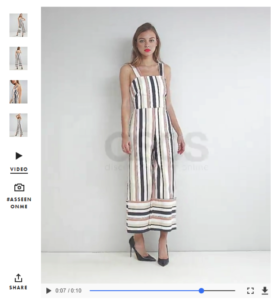
Where Free People have used the photo craze to engage their customers, other ecommerce brands use video very effectively. Take ASOS as a point in case. Online shoppers can see a desired garment modeled in front of them by using the catwalk feature. This is a great way to communicate more about your products and give your customers something that’s useful and may well lead them on the path to a purchase.

Personal Video Image Credit: ASOS

But video can be used by brands in incredible ways – imagination is the only limit. Thought leadership content is often created using video as a medium; product unboxing and beauty reviews as well as a ton of user generated gaming content is all available at the touch of one or two small buttons and a screen. A mobile phone is often the only piece of equipment required to make engaging, quality video that’s easily shared. Social channels like Instagram, SnapChat and Facebook are owning this format and making it very personal indeed. In fact all social channels have become more video oriented in response to what audiences want.

If you’re ready to jump in a little deeper, why not seek out a local freelance videographer or content agency,or social strategist and talk about how video could be used to help increase sales. Video is fun, engaging, accessible and incredibly popular. It can often say everything you want to in seconds rather than minutes or even hours – and it’s great branding.

Chatbots

A chatbot is effectively a program that translates a user’s command or question and returns an answer. Lots of digital companies use chatbots to more efficiently help customers on their website. Those little bubbles you see pop up when you’re browsing a site, asking if you need help, or if you want to talk? They aren’t there so you can chat to a random stranger about your day, they’re a bot that is there to efficiently move you on to the next stage of your buying journey.

Of course, we also have voice activated chatbots like Siri, Cortana, Alexa and others. These bots are becoming more and more sophisticated, and as your connected devices collect more data about you, they’ll be even more effective at responding to your requests. AI is the next leap in the technology of our lives and it will have a massive impact on the way we shop. Chatbots are already being used effectively in marketing around the world and this Nordstrom mobile chat bot, reported on in December 2016 via GeekWire is a great example of how.

For now, get familiar with chatbots and how they may be able to help you more effectively meet the needs of your customers when they are browsing your ecommerce site.

Hopefully that’s given you some food for thought and you’ve enjoyed our ecommerce marketing series!  I’d love to hear what kind of marketing technology and software you’re using to scale your ecommerce stores, and if you’ve used any of the methods mentioned in this post?

Patrick FosterPatrick Foster, ecommerce entrepreneur, coach & writer.


I currently create and share ecommerce content for entrepreneurs and business owners. I’m especially interested in the emerging technology for online marketers.

Ecommerce Marketing Trends for 2017: Beyond Personalization I

Ecommerce Marketing Trends for 2017: Beyond Personalization I

Today’s contribution comes from Patrick Foster, an ecommerce consultant and writer at ecommercetips.org.


We are already into the third month of Q1 2017 – gasp. And there are a lot of emerging ecommerce marketing trends you should be considering as part of your strategy. Building and defining a loyal customer base is critical to the success of your ecommerce brand, and keeping up with the latest trends in communication methods can be tedious. With so many channels, platforms and content types – how can you ensure your marketing is personal and effective? Here is the first blog of our content series looking at ecommerce marketing and personalization in 17/18.

Ecommerce marketing in 2017 is not just personalized, it’s personal; competition is hot, and creating an emotional connection is critical to success. We’re going to look at the most people-centric marketing techniques of 2017 and introduce some new concepts that might challenge your idea of what ecommerce marketing is capable of.

Email is in vogue

Before we get into the really crazy stuff, let’s not forget the humble, yet effective email. You heard it here first kids —  email is back in vogue.

It’s always been there, doing its job and not taking much of the limelight. And despite suffering through somewhat of a dark period of black hat tactics like spamming and phishing, the simple yet effective email has redeemed itself.

There are such a huge range of CRM systems and specialist email platforms on the market, such as Infusionsoft – that there really isn’t any excuse not to be collecting your customer’s basic  contact details, and communicating with them regularly. A streamlined CRM system is the first step toward making your online data work for you. It will save you time, effort and hassle and you’ll be able to make much more granular decisions based on the conversations you have with your customers.

Email is a really simple and often underrated way to offer added value during the purchase journey of your customer.

Actionable data and AI

Big data, the IOT (Internet of Things), targeting, re-targeting, tracking, advertising and cookies: it’s all ecommerce marketing – and it’s all based on data analysis.

Collecting data on your customers and your site are crucial for your brand; but what is data if it can’t be actioned and properly deployed? It’s nothing but a useless bunch of names and numbers. In 2017, data is about helping brands get even more personal with and closer to consumers.

Marketing is driven by data —  this isn’t a new concept. But with more connected users and devices globally, data is driving advanced personalized marketing and advertising. The IOT is making it possible for ecommerce brands to learn about customers in real-time, and send marketing instantly to consumers in the right place at the right time.

Apple Watch

Smart devices, AI and Wi-Fi connected gadgets can read data in a room, from temperature to light, and pass it on to other connected devices. The IOT has gone well beyond personal to the point where our tech is making choices for us. For marketers, harnessing the data and using it in the right way is going to be the real challenge.

Facebook and social shopping

Have you noticed the little shop front icon on your Facebook page? That’s Facebook Marketplace. Relaunched in 2016, Marketplace connects users in your locality with items for sale. The feature makes product suggestions based on search history and other data that Facebook collects from your personal profile.
Marketplace is yet to achieve any impressive milestones, but that’s not to say social media hasn’t already begun to change the way we buy and sell online. Peer to peer recommendations, product shares, page likes, Facebook advertising, in-stream video advertising, Instagram advertising: the list goes on. And brands are loving it. But being in front of your audience when they want to research products or make purchases is key.

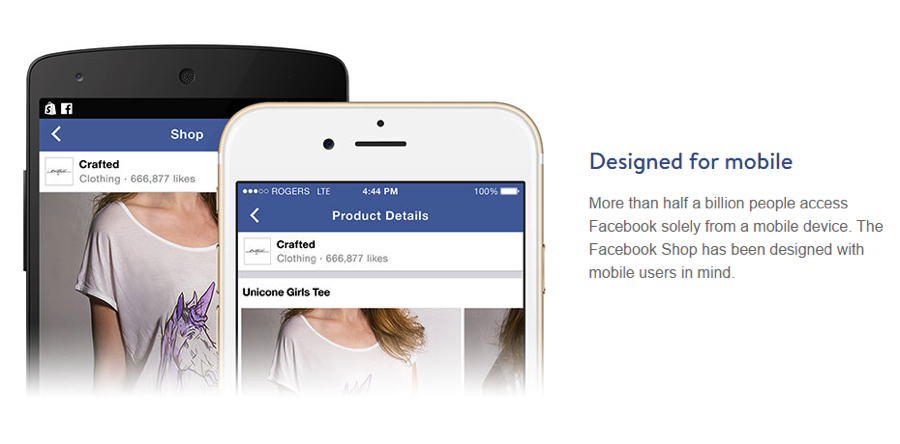
Facebook Shopping

There are a number of out-of-the-box website solutions you can either purchase, or use for free, to set up your ecommerce brand. Great. But not only can you sell via your integrated website, you can now sell directly through native applications. As audiences walk around or sit at their desks constantly connected to brands via their mobile devices, it makes sense their shopping habits should shift there too. To be in front of your audience and have a personal connection with them, join the native-revolution of engaged ecommerce brands who are connecting via social channels and apps.

Pinterest’s buyable pins are driving ecommerce sales founded on a deep understanding of visual content, where selling and social stories become almost unrecognizable. But it’s not just the social channels muscling in on online sales, even the big ecommerce brands are ‘going native’; Shopify’s integrated Facebook store allows subscribers to reach their audience, via – you guessed it, Facebook. The Shopify integration allows customers to buy and track orders through messenger – another interesting development in conversational commerce.

You now have the opportunity as an ecommerce business to integrate with native applications via standalone ecommerce platforms and with social media platforms’ own marketplaces. Which one will prevail as the most popular for audiences is something to keep an eye on, and to conduct brand strategy conversations around.

Native developers and brands are coming together to make ecommerce simpler for the consumer, and much more highly targeted. Brands will have to decide whether to leverage the opportunity of selling directly to customers via native platforms, or put their efforts into keeping them on site, where the data is, and leverage that data to increase revenue.

Some of these personal marketing tactics, especially AI influenced, are still a little too close to home for some of us, but it’s interesting and exciting to think what the not too distant future of ecommerce will look like. Ecommerce marketing is a dynamic mix of getting the most out of tried and tested methods like email, and exploring new ground like AI. Whatever you do, make sure that you focus on bringing in customers; keep evaluating your marketing ROI. Read on in blog number two!

2017 Marketing Automation Predictions

2017 Marketing Automation Predictions

Hi-diddly-ho reader-inos!

Besides promising not to channel my inner Ned Flanders for the rest of this post, I’m excited today to share a post that isn’t my usual technical ninja stuff.

Rather, since I see a lot of businesses and technologies, I wanted to share what I believe are the trends you’re going to see more in Marketing Automation for 2017.

Why do you care? Well, for starters, some of this stuff is really cool and could probably benefit your business. Next, knowing what is possible with technology is very important to stay competitive. That doesn’t mean you have to master using the technology, you can always hire people for that, but its good to have a general understanding so you can strategize properly.

Marketing Automation Prediction #1 for 2017: Automated social funnels

Social FunnelIn the past year or so, the savviest of marketers have begun aligning their social ads with their sales funnels. Basically, if you are in the middle of a launch (for example) and getting hit with launch emails, when you are trolling around Facebok you also see the same launch messaging via ads because you are in that part of the funnel.

True omnichannel marketing used to be really hard, if not nearly impossible. Thanks to Google’s and Facebook’s tracking pixel we can now do remarketing easier than ever which is the key tactic for these automated social funnels.

If you give your name/email for some free resource and you don’t download it right away, you’re going to start seeing ads reminding you to download it until you do. That kind of stuff is going to become more common in 2017.

Marketing Automation Prediction #2 for 2017: More robust and meaningful data centralization

Technology is great. However, in our modern age of digital tools, getting data from the different systems into one holistic view can be a severe challenge. Especially for small businesses.

Aggregate DataThese past few years we’ve seen more and more tools that exist solely to connect different systems together. A great example is Zapier. It is a platform that allows you easily connect different services together automatically without writing any code.

For a more ground level example, if an order comes in through Infusionsoft, Zapier can push an invoice into your accounting system whether or not there is an official integration with Infusionsoft.

The next evolution of these services that act as a connection platform is the reporting aspect. That is why we’ll see centralization of all this data as a big trend over the next 12 months.

As more and more of these Zapier-like services crop up (IFTTT, Workato, etc), the data visualization and reporting functionality is going to become a critical feature (if not THE most important feature).

Because at the end of the day, if you are spending money on tools and cannot trace that expense to inbound revenue, you can’t make educated business decisions.

Marketing Automation Prediction #3 for 2017: More push notifications

This was one that I think is going to be the next “big thing” for marketers. Push notifications are those little messages that show up on your phone from different apps. You got a text. CoolGuy333 made a comment. That kind of stuff.

Push notifications can also exist for browsers too.

In the past year I saw a few big names test this technology and saw a handful of services show up. If you see the big dogs testing stuff, its worth keeping your finger on the pulse to see what happens.

Turns out there are many ways this kind of technology can be used. On the website it can be used to engage prospective buyers into a conversation or drive them to a particular resource. For any kind of software or app, it is one of the most powerful engagement tools in your arsenal.

Case in point: I have some apps on my phone that I NEVER use. But every once in a while a notification will crop up and I’ll open it because why not. Boom! That notification just got the user back into the app 🙂

This is not the “silver bullet” that the gurus probably will make it out to be. Rather, it is another digital messaging channel that can be customized and used to enhance the customer experience. Put simply: your strategy needs to be sound if you are going to use push notifications (just like any other channel).

What do you think? Do you disagree? Leave a comment and let’s discuss!

3 Marketing Lessons from the 2016 Election

3 Marketing Lessons from the 2016 Election

Hello Monkeypodders!Sokol

It’s your favorite Mad Scientist back with another guest post that totally isn’t a newsjack 😉

Before we get into the political marketing lessons, let me assure you this is not a “political post” per se, but rather the same kind of high quality marketing education you’d normally expect from this blog.

You ready? Let’s go!

The conversation around who America’s next president will be fully dominates mainstream US media these days, and is garnering plenty of attention worldwide as well.

Even small local news stations are bound to mention it in some form or fashion. While the choice hasn’t been made by the people yet, there are some political marketing lessons emerging from which we can extract very important insghts.

Especially since we’re all probably gearing up for some holiday campaigns, right?

#1 It’s the offer, voter!

At the end of the day, Americans are going to make individual choices of who they think can lead the country best. As far as what a candidate offers, the person voting for them resonates with their message the most out of the available choices. In other words, when we step into the head of a voter, if the problem is “I need a leader for America” then the solution is candidate X because they offer Y. And that sounds the best to me personally as the voter.

Chances are the problem you help solve for people has competition. Other businesses are out there solving the same problem. Sometimes better than you, sometimes worse. What causes people to “vote” for you (you’ll see more about this later in #3) is what you are offering, and how you are offering it. Specifically, it’s the positioning of what you are offering to the audience you are targeting. McDonalds sells hamburgers to both children and adults.

Do you think they would talk to those two audiences about the same offer in the exact same way?

(Pssst, the answer is ‘No’)

If you haven’t lately, there may be some benefit to sitting down and getting really clear on the 1 or 2 ideal customers you have (you can define your avatar here). Then, look at what you offer and how you can talk about it to those customers in a manner that positions it in the most appealing way.

You may notice that political candidates often emphasize different aspects of their plans and policies depending on the audience they’re addressing, the current issues having around the world, and even the specific geographical region they’re speaking to.

Re-doing your offer’s positioning and using what you discover in your marketing can often help get better results from your efforts; unless the offer itself is truly bad.

#2 Email is still a relevant channel

In past elections, I’ve signed up for the mailing lists of the major candidates to see what they’ve been doing.

Lately, I don’t have the time to study those like in the past, but you know that candidates are still sending email because it still works. It’s still relevant. Remember, email is literally the electronic version of physical mail. That will be relevant for a long time. At least, until we get t-mail or something and stuff gets transmitted into our thoughts.Email Marketing Image

Email as a communication channel is great because you can get personalized messaging just like with a physical letter. We must always remember this when writing emails no matter how many people will see it. It should feel like it was written for the reader and only them.

Relevant doesn’t mean positive ROI though. You can still send a bunch of emails that nobody cares about. To avoid this, make sure you are considering the entire customer experience up to that email and what will occur after that email. Here’s a blog post Greg wrote a while back where he highlights a key distinction most people miss regarding email permission.

Oh, and make sure you are also tracking the important stuff too. A high open rate feels good to your ego, but if all those opens generated zero clicks, what did that actually do for your business?

More importantly, what did it do to the relationship of your business to that individual? It certainly didn’t help.

Polling Station#3 People “vote” with their dollars

Imagine if you will, for a moment, two businesses. Business A and Business B. They both offer the same product. Literally, they both source it from the same manufacturer. Who gets your business?

The one you like better.

Any election is ultimately about individuals putting down which candidate they like better for the position in question.

In the world of business, a dollar is like a vote. When you buy food from your normal place, you are “voting” for that place to stay around. When you go to your favorite restaurant, you are “voting” for them to keep doing what they’re doing. This is the reason we feel good about patronizing local shops, and farmers markets; we can interact directly with the people we’re giving our vote too.

It is good to remember that while you are doing your business thing, people also still need to like you. For some industries you cannot be in business if people don’t like you. Other times it doesn’t much matter as long as the job gets done.

For those kinds of situations, take an objective look around and see if there are small (like really small) tweaks you can make to improve your like-ability. Adjust your live phone greeting to be more friendly. Iterate a couple subject lines. Invest in a simple thank you letter in the mail.

The point is, the more they like you, the better the chances they will “vote” for you in the future.

(If you want to dig into why its important for people to like you, check out Cialdini’s book ‘Influence‘. There is a whole chapter on it and the rest of the book is a goldmine for small business owners.)

What do you think? Did any of these political marketing lessons resonate with you? If so, please “vote” by leaving a comment!

Editor’s Note: Paul is a former Infusionsoft Employee, on the Monkeypod OG Expert panel, and is generally well respected member of the Infusionsoft ecosystem. He is responsible for the design of most of the campaigns in the Infusionsoft Marketplace, and is also the author of The Infusionsoft Cookbook. If you’d like to receive content directly from Paul, you can do that by signing up here.