Lifecycle Marketing, Marketing, Small Business
“I need more leads.”
What small business hasn’t said this? Honestly, I’ve worked with enough small businesses that the meaning of this sentence has nearly worn off. In fact, I said something similar recently and I had to call myself out on it.
“I need more leads” is the second lead nurture myth. Because, no, you don’t.
I’ve said it before and I’ll say it again, I believe that nurturing your prospects is the single biggest thing you can do for your business without spending an additional cent.
Nurture is all about doing more with what you already have. There are plenty of ways to generate leads, and I know that there are variou s sophisticated methods for telling you the cost of each acquisition. But rarely do I see people focusing on the number of leads that they aren’t capturing. Or those that they have captured and still aren’t converting.
There’s a fundamental flaw in the way I see a lot of small businesses talking about lead generation. The problem is that most people see their conversion rate as a fixed percentage. Here’s what I mean: Say you get 1000 visitors to your website, and you capture 100 leads, and 10 of those leads become customers.
Now if I tell you that you need more customers, most businesses would say “Okay, well then we need more leads.” Some would say that they need more visitors. Because they see those numbers and they are able to infer that as they trickle down they turn into more customers.
But there’s another way to get more customers out of this equation without changing the number of visitors or leads.
I’m a basketball fan, so I’ll put it in terms of basketball for ya.
Let’s say a basketball team takes 60 shots, and makes 10 of them. And they’re losing the game. So they call a timeout to talk about it. Is the coach going to say “We need more shots!”?
No. They’re getting plenty of shots, they’re just not making enough of them. Similarly, there are two ways to grow your customer base, you can get more leads into your funnel, or you can convert the leads you already have at a higher rate.
(Okay, here’s the COA, yes, some businesses genuinely need more leads. But more often than not even those businesses also have room to improve by converting at a higher rate. If all you’re focusing on is the number of leads you’re getting, then you’re missing a critical part of the equation.)
Now, I don’t want to downplay the impact that new leads can have on the health of your funnel. I think that it’s really important. But I was talking with my friend Jacki McLenaghan recently and she said something to the effect of “Small businesses don’t have awareness problems. They have process problems.”
And we went on to discuss this further and she’s pretty spot on. (Here’s our chat)
We live in the most connected day and age that there has ever been. You can build a website today, and start selling online, internationally, tomorrow. Between all the various paid advertising channels, and through organic reach with your existing social channels you can get eyes on your website.
It’s the “what happens next” part that people really struggle with. And that’s where you need to have a nurture process in place.
Now, I wish there was a single barometer for success so that you could easily tell whether or not you were efficiently converting leads into customers, but even if there were then you’d be comparing yourself to other businesses without really knowing if your businesses were the same. I recommend  tracking your own conversion numbers, and comparing against where you used to be. How many new leads did we bring in. How many new customers do we have. The number of new customers divided by new leads is your leads to customers conversion percentage.
Long term, you may even want to look at your average sale price so that you’re assigning dollar values to these leads instead of just counting the number of customers. There are plenty of numbers you can dig into to really get granular on this process, but all I’m asking for now is that you revisit the way you’ve been thinking about this.
Think of it this way, if you have a juicer, and it does a really poor job of making juice for you. Maybe it’s broken, or maybe it just isn’t very efficient. You don’t need more fruit to shove into it, you need a better juicer. In fact, it almost doesn’t make any sense to put a single additional piece of fruit into it UNTIL you’ve fixed the juicer.
Well your nurture funnel is exactly the same. You don’t want to focus on getting a bunch of new leads until you’ve optimized the existing funnel for the leads you already have.
Look at your business honestly and ask yourself if you need more leads, or if you need to do more with what you already have.
Customer Experience, Keap, Lifecycle Marketing, Marketing, Small Business
The first thing you need to know is that Lifecycle Marketing transcends Infusionsoft. It’s a stable concept for small businesses everywhere. The common mistakes I’m going to outline here are not unique to Infusionsoft users. They’re prevalent throughout the small business community at large.
Lifecycle Marketing (or LCM as I’ll call it) is the strategy around which Infusionsoft encourages you to build your business. As a consultant and trainer at Infusionsoft, I saw it work time and time again. And, I also got to see plenty of businesses who couldn’t stay afloat, or just struggled because they didn’t adopt it. Well, they either didn’t embrace it, didn’t understand it, or didn’t execute it. Let me outline 3 icebergs that could sink your LCM ship.
 For those who don’t know, Lifecycle Marketing involves designing a process, or several, that will take your customers experience into account during every single step along their customer journey. This means that everything from opting in to your list, all the way to making repeat purchases has been planned for. Learn more here.
1. LCM isn’t Static
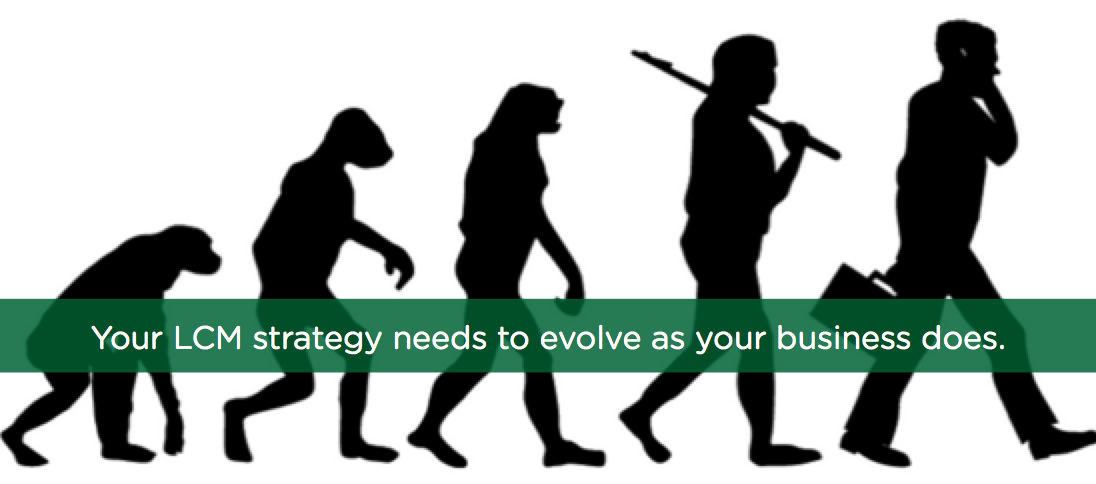
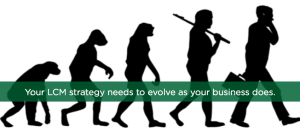 It needs to evolve. As your business changes, so to should your lifecycle marketing strategy. Too many businesses work through their LCM strategy, and then never revisit it. The reality is that small business lives in a constant state of flux. Your business looks different today than it did three months ago, or a year ago. It’s important to carve out regular time to revisit your LCM strategy and make sure that it reflects your current needs.
Action: Carve out a full day once a quarter to revisit and audit your LCM strategy. See what has changed in your business, and if anything needs to change in your LCM approach.
2. Too Simple to Work
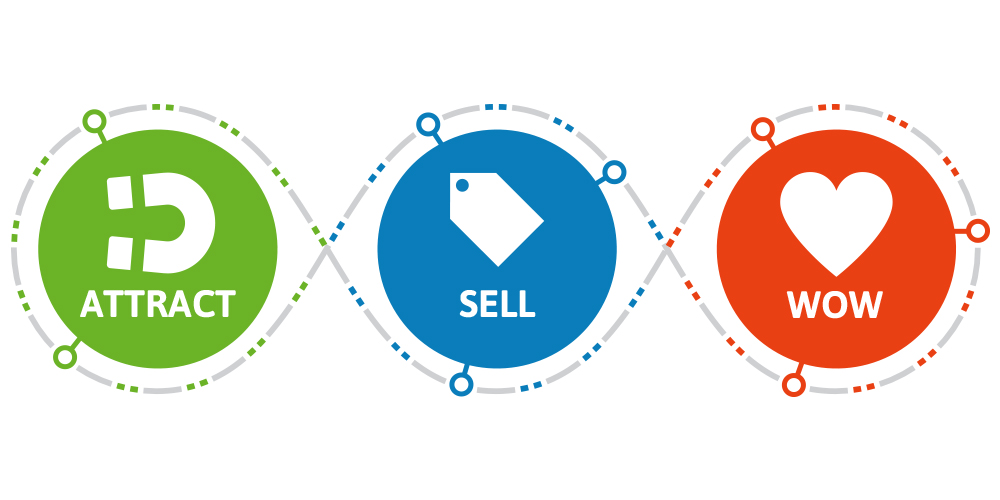
 I’ve seen it happen over and over. A small business owner is presented with the concept of Lifecycle Marketing and they’re underwhelmed by the graphic, or the explanation, or both, and so they dismiss it. Well, the reality is that the graphic isn’t all that impressive. I don’t think too make people look at it and say “Oh, SELL, that’s the piece I’ve been skipping.” But I do think there is value in the LCM graphic, and to me it’s in the connections between the stages. Far too often people tend to look at Lifecycle Marketing as these independent stages that comprise a strategy. When in reality, the real magic of an LCM strategy is in how the stages tie together. The intentional focus on transitioning prospects from one stage to another can be the difference between prospects becoming customers, or slipping between the cracks.
Action: Don’t take the graphic at face value. Look at how your LCM stages tie together, whether or not they were designed with respect to one another, and whether or not you’re creating a cohesive customer experience.
3. No Natural Nurture
To me, the easiest thing you can do to get more customers is develop and implement a nurture funnel. There are generally two ways to get more customers- either by getting new leads, or by converting the leads you have at a higher rate. Nurture is all about doing more with what you already have. (I feel like I’ve said that before) The reality is that most people agree with this, but very few actually do it. The biggest reason people aren’t doing this is because they don’t know HOW to do it. They’re confronted by question s like: Where do I begin? And What do I say? How much is too much? And if they can’t immediately answer, then they end up paralyzed and nothing gets done.
Well, I’ve got 11 questions you should walk through to help design a nurture funnel that works, and it starts with “What is the GOAL of my nurture?” (Hint: It may be more complex than ‘buy something’) If you’re looking to build, or refine, a nurture process, you can download the 11 questions here.
Action: Start with these 11 questions. Then find a tool (I recommend Infusionsoft) and build a nurture funnel that automatically follows up with prospects, and builds a relationship, provides value, and fosters trust.
There isn’t a single surefire indicator for whether or not a business is going to become a wild success, but having a solid Lifecycle Marketing strategy, and executing on it, will certainly set you up for smoother sailing.
Oh, and if you use Infusionsoft, check out my LCM: Real Life course – it’s all about bridging the gap between LCM theory and the actual campaigns that support it. And you can get the first module for free!