Keap, Uncategorized
Me: Are you really going to interview yourself?
Greg: Yup, we’re doing this, let’s go.
Me: Okay, but don’t you wanna at least explain what you’re doing so people don’t think you’re weird?
Greg: Nah, they’ll figure it out. Plus, I’m excited.
Me: Okay then, you’re the boss. Tell me about the IS Starter Kit.
Greg: It’s my latest course, and it’s freaking awesome. I’m really excited.
Me: Yeah, obviously. What’s the course about?
Greg: Well, it’s an Infusionsoft course. It’s 40 modules long, and it jumps around quite a bit. The easiest way I can describe it is “It’s all the things you didn’t know you needed to know.”
Me: That sounds appealing, which was probably the goal.
Greg: Yeah, I wanted this course to be a good fit for most people.
Me: Smart. Why did you create this course?
Greg: I created this course because I realized that a lot of people just start using Infusionsoft, and they learn things the hard way. Then, the hard way just sort of becomes their status quo. I can’t count the number of times that an entrepreneur has said to me “I wish I had known that at the beginning”. But the reality is that your introduction to Infusionsoft is rapid, and can be overwhelming. This course is designed to answer 40 questions that most people skip over when they’re just getting going.
Me: Are you going to tell us what the 40 modules are? Or just keep bragging about them?
Greg: I don’t think listing 40 questions is the best use of this interview. But if anyone is curious, they can download the course agenda here.
Me: Isn’t there a risk that people will already be able to answer some of the questions?
Greg: That’s not a risk, that is a fact. There are 40 modules, and some (or most) will probably be review.
Me: What? Are you sure people will want that?
Greg: Well, that’s the whole reason this course is so inexpensive. I don’t think it’s groundbreaking. I don’t think this course is revolutionary. It’s just really solid information. And if you’re going to build something that lasts, the foundation matters. I think that Infusionsoft gets easier every time you log in. And each time you answer a question or understand a new feature, it makes the software that much more approachable, and that much less intimidating.
Me: All I heard was inexpensive…
Greg: Yeah, The course is $57 dollars (though my members are insisting that I need to raise that), and there’s a massive launch discount as well. I wanted this course to be a no-brainer for people.
Me: Is $57 really a no-brainer?
Greg: Well, I think about it this way: There are 40 modules. You don’t need 40 groundbreaking new concepts. You only need one answer, or one new feature that saves you time or earns you money; and I get 40 tries. I like those odds, in fact, I like to think that it’ll probably happen more than a few times. Plus, it’s going to get better and more valuable over time.
Me: What do you mean it’s going to get better?
Greg: Oh, right. Well, this course is going to evolve. As people give me feedback and make requests, I’m going to record and add new modules to it overtime.
Me: Cool. I like that. Will those cost extra?
Greg: Nah, as long as the course is unlocked they’ll get access to any new modules I add.
Me: So, this course is for new Infusionsoft users?
Greg: Definitely. But here’s the deal, it’s for anyone who feels like they’d benefit from understanding Infusionsoft better. Or for a team member who you desperately want, or need, to hand the reins to. Yeah, ideally we’d all learn these things as we’re just getting started – but that’s not the reality. Often times when you’re starting with Infusionsoft you’re sprinting to get something done, and you don’t take the time to really look around, or to get familiar with all the different settings and features.
This course surfaces the things you didn’t even know you needed to know. And knowing them now, whether from the beginning or retrospectively, is going to make your business and your sales and marketing more effective, more efficient, and give you more confidence and freedom to be able to do what you need and want to be doing.
Me: So, it’s for new users, but also for users who aren’t new? Isn’t that cheating?
Greg: Yeah, maybe. It’s also great for people who manage Infusionsoft for other businesses.
Me: How so?
Greg: Well, think about this – Let’s say you use Infusionsoft for your own business, and you’re really good at it. Well, maybe you’re using 50% of the software. So, you get really comfortable with that 50% of the application. But if a client of yours needs something you don’t use, then you’ve gotta figure it out.
Me: How does this course solve tha-
Greg: Haha, I was getting to that. This course isn’t built for any one specific business – it’s built to answer some of the most common questions, AND to shine a light on some of the less commonly used features. If everyone understands exactly what Infusionsoft does, and how it works, then they can make an informed decision as to how they’re going to use it.
Me: Killer. So, it’s kind of for everyone.
Greg: Exactly
Me: No one is that altruistic. What do you get out of this?
Greg: I get the opportunity to teach. I love this stuff.
Me: ….
Greg: ….and if they like learning from me, and think it’s valuable, maybe it’ll open the door for my other courses, or my membership.
Me: That makes more sense.
Me: Alright, so, how do people get started.
Greg: Well, people can buy it here – but honestly, I’d really recommend checking out the free trial. That way everyone can get a sample of the content, and they can make sure you’re not allergic to my voice or something.
Me: How long do they have to make up their mind?
Greg: The course isn’t going anywhere, in fact, it’s just going to imrpove. But the launch discount expires on August 26th, and 12:00 pm Eastern US Time.
Me: Think anyone is still reading this?
Greg: I dunno, hopefully they’re halfway done with the course by now.
Me: Do you think this was awkward to read?
Greg: Probably. But it was even more awkward to write…
Me: Good point. What are the best and worst case scenarios for someone who reads this whole post?
Greg: Geez. Worst case? They hated it, think I’m an ass, and I miss out on an opportunity to help them get more out of Infusionsoft. Best case would be they grab the content, love it, and then tell me that this blog post was the most brilliant sales copy they’ve ever read.
Me: Okay, anything else you want me to ask you?
Greg: Nah. I’m just excited about this course and looking forward to hearing how it makes a real and meaningful difference. Because I believe it will.
Guest Posts, Keap, Small Business
We’re back with more knowledgey goodness from the Mad Scientist. In case you missed the first part of this post, check it out here. But to bring you up to speed, we’re talking about the different use cases for a pipeline.
Species #2: Fulfillment Pipeline
Sometimes, the sale is relatively simple but the fulfillment process is long and involved. In these cases, you can use a pipeline to track the specific fulfillment process.

For example, in the past I worked with a company that sold solar panel installations. Obviously, that fulfillment process is very complex because it involves inspections, sourcing parts, getting permits, etc. To streamline this process, we created a pipeline tracking the key milestones such as “Inspection Scheduled”, “Inspection Complete” and other critical parts of the installation. They even used custom data fields to track fulfillment specifics such as inspection dates, part numbers and permit information.
Another fulfillment pipeline example comes from my days as an Infusionsoft Success Coach. Basically, when someone purchased our software I would work with them initially to get their system setup. To track my book of business effectively while still doing 6, one hour calls, back-to-back each day, I setup a coaching pipeline. I had different milestones as they scheduled/rescheduled and completed different calls. I even had some milestone stages to track key behavior, such as sending their first email broadcast. Those milestone stages would be used to do some data crunching in the background so I could at-a-glace see my coaching pipeline status.
Unlike the sales pipeline, these fulfillment processes can have more milestones but still keep in mind that you’ll want to minimize them down to the key components to avoid the risk of human error.
As far as automation, you’ll want to use it to supplement the fulfillment process, much like you can do with the sales process. Using the solar panel example from above, when someone moves into the “Inspection Scheduled” part of the process it can send an immediate email that says “Hey your inspection is coming up here is what you need to know”. Or something like that.
 The automation can also be used purely for data crunching too, like I did with my coaching clients. In that specific example, I had an objective to get my customers through 4 usage behaviors such as sending a broadcast or getting a web form on their site. To track how many usage points someone had, I had each of those usage behaviors as a milestone in the pipeline. Each time someone hit that milestone, the system would do some data manipulation on the backend so I could know if people were tracking to fully launch by the end of our coaching time together. Frankly, if I didn’t do this automated tracking, it would have taken me HOURS each week to report on my book of business, rather than a two minute glance at my dashboard.
Species #3: Live Event Acquisition Pipeline
 Certain products have in-person fulfillment. A live music concert or speaking at a professional conference are two examples of a product where people are buying your in-person experience.
Similar to the two previous pipelines, this kind of pipeline is tracking either the sale or fulfillment (or both). However, the product itself is the focus, not the person buying the product. In other words, you might have 50 lead records in the sales pipeline but as far as a live event is concerned, you’d only have one event record.
Let me share two examples using the entertainment-based product, and then the functional product. By day I’m a automated experience designer but at night I’m a headbanging metalhead who is also a show promoter. My company is actually the official in-house booking agent for a local venue out here. To track our show bookings and talent acquisition, we have a show pipeline. It starts from the initial outreach by a promoter/agent looking to do a show and tracks all the way down through securing the show date, contract signing, and ends with the show officially booked and ready to promote. This allows us to have many shows at different stages of development organized in a clean fashion. Plus, there is a team of 3 of us, so having a central event record ensures that everybody can be on the same page even if we cannot directly chat at the particular moment.
Regarding automation, while we haven’t built anything yet, we could easily add in automated emails to nudge a booking agent on contracts and such.
In the case of a professional speaker, acquiring speaking gigs can also benefit from having a pipeline very similar to the entertainment based product. You still have to secure dates, get contracts, etc. However, you can take further organize by including operational data too.
For example, many years ago I helped Chris Brogan build out this exact idea: a speaking engagement pipeline. In addition to the stages, we also built data fields to track the airplane tickets, hotel and rental car info. We even created Yes/No fields to indicate if those had been done and that was used for certain reports. Another example is my good friend Steve Gabriele who does sports photography. We setup a pipeline for him that, in addition to tracking hotels and such, also allowed him to track how many employees each event needed, estimated fuel costs, and all sorts of critical operational information.
Whew! Thats it for now but I’m really curious: what did YOU take out of this post? Please leave a comment below!

Guest Posts, Keap, Small Business, Tips and Tricks

Paul Sokol, Data Scientist, Infusionsoft
The original Campaign Builder Mad Scientist is back again to drop some knowledge on us all. You guys may know Paul from past hits such as Infusionsoft for Non-profits, 5 Massively Underused Infusionsoft Features or as the author of the IS Cookbook. Regardless, he’s back, and has pulled some more wisdom out from under his glorious hair. Enjoy.
3 Species of Pipeline and How To Leverage Automated Experiences
Ahoy hoy Monkeypodders! Its your favorite mad scientist and automated experience authority Paul Sokol with another guest post that, hopefully, you’ll be able to use in your business somehow. Infusionsoft user or not.
So here’s the scoop: in most businesses there is usually a long drawn out process of some kind. Now, this process may not be technically difficult but rather it simply takes time. For example, if you are providing construction services it takes time to get permits and inspections and such. To ensure smooth operations and governance over the process’ integrity, a pipeline can keep everything organized like a well-oiled machine. More on that in a second though.
A process that would warrant a pipeline can exist during the customer acquisition phase, during post-sale fulfillment or the product itself can warrant its own pipeline. In this blog post, my goal is to share more insight into these three kinds of pipelines I’ve seen in the wild (and personally used) and how you might be able to leverage humanized automation to intentionally create a delightful customer experience.
This is not to say that more species of pipeline don’t exist. To say that would be ignorant. Even in the real world we are discovering new species of life at exponential rates. Who knows, maybe in the future if I encounter a fourth distinct type of pipeline you’ll get another guest post 😉
 Before we begin I need to briefly explain the notion of a pipeline because there are some different definitions out there. I personally use the word (and thus how it should be interpreted when reading this post) as a way to describe a manual accountability tool whereas someone can track an individual customer relationship through a clearly defined process with a defined outcome.
I know that sounds wordy. Let me clarify a bit.
A process is nothing more than a series of steps in a specific order to achieve some outcome.
Steps and Order. There are certain steps you take when getting out of the shower in a specific order to prepare yourself for public appearance. You don’t get out of the shower, get dressed, and then dry off. Process = Steps in a specific Order.
A pipeline is a mechanism to track a process at a scale. The lone solopreneur might be able to keep 3 or so sales leads together in their head, but good luck juggling 50 active leads. The process only works in their head to a point.
Lastly, for a pipeline to work the process it is scaling has to be clearly defined. You can’t build a pipeline for a process that doesn’t exist.
Species #1: Sales Pipeline
 Selling a house takes time. Selling someone a $25K mastermind might take a long conversation with multiple touch points. Selling someone a $5k/month consulting retainer absolutely takes a longer more involved conversation.
When it comes to offers that have either a high ticket price (with respect to the target market’s perception of price) or something that has a long buying cycle, a sales pipeline can be very handy.
As far as the sales process, the pipeline is tracking the key milestones in the relationship. Here are the recommended pipeline stages for the beginning of any sales process.
New Opportunity – The contact has been identified as someone we should call, that’s it. No action has actually occurred.
Contacting – The sales rep has made at least one attempt to get a voice-to-voice conversation and has not reached them yet.
Engaging – The sales rep has made contact but has not yet identified if the lead is qualified to proceed further down the sales process.
Qualified – The sales rep has verified the contact has a real problem, budget and the authority to spend the budget.
Once someone is qualified, there are usually only a few milestones after that, based on how you sell. They usually happen in pairs too. For example, “Demo Scheduled” and “Demo Completed”. Or “Proposal Sent” and “Proposal Accepted”.
As a general guideline, your sales pipeline should only have 6-8 distinct stages besides the Won/Loss stages at the end of the process. This also ensures that your people will be able to easily use the pipeline without getting confused.
Regarding automation, you’ll want to use it to supplement what the sales rep should already be doing anyway.
For example, if a lead is in the Contacting milestone, there can be a series of emails from the sales rep that basically says “Hey I’m still trying to reach you”. Or, if you have a “Proposal Sent” milestone that might be a series of emails that says “Hey what’d you think?”
Bonus Super Ninja Tactic: “Invisible Sales Manager”
The “Invisible Sales Manager” is an excellent way to keep track of sales reps and their performance. It also really begins to paint the picture for how powerful good automation can actually be.
Here is how it works: For each sales milestone, have a timer that waits until long after the next milestone should have happened. For example, someone shouldn’t be in Contacting for more than about a week. You can set a timer for one month and, if they are still at that point in the process, have the system apply some note and notify the sales manager that the lead has been stale for a month. Now, there is documentation of the occurrence (in case this is a recurring problem with a particular rep; you now have hard evidence) and the sales manager knows they need to have a conversation.
This post got a little longer than expected, so we’ll bring you the 2nd and 3rd species in a day or two.
Keap, Tips and Tricks
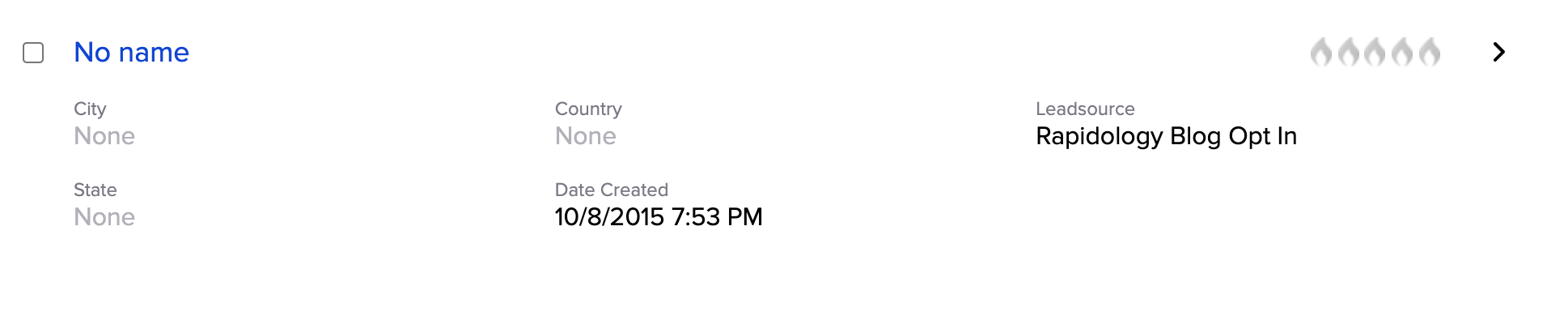
 Today’s blog post on Keap Leadsources comes to us from Mike Hilton – current member of Keap’s product team, and former member of the Keap Customer Experience team. That means that his focus was improving the experience Keap creates for their customers – and that’s something I can get behind 100%.
Turns out that Mike isn’t just a Customer Experience advocate; he’s also a pretty sharp Keap user with a mastery of a number of tools and tie-ins that help stretch Keap. Well, today’s post doesn’t require any extra integrations; and it should resonate clearly with any Keap user who has ever struggled with tracking multiple leadsources through the same opt-in form. Take it away Mike!
Simplifying for Sanity
Why do some people freak out and start to sweat when they see:
- a² + b² = c²
- Microsoft Excel™
- “?firstname=~Contact.FirstName~&lastname=~Contact.LastName~&…”
The answer could be that each of the above examples is tied to discomfort and painful memories, but more than likely it is because they haven’t felt they could benefit from understanding how they work in the real world. Today, I am not going to focus on using the pythagorean theorem, or Microsoft Excel™, but I want to demystify the junk that comes after a URL
My goal is to teach you how to use Keap LeadSources to track contacts from multiple channels without having to duplicate the same webform over and over and over again.
To understand that junk (also known as the Query String) you need to understand 3 simple characters and how they work to make your life easier:
- ? – Question Mark: tells the page that you have some important information to pass along with the URL (ie – contact information, id numbers, lead sources, etc).
- = – Equal Sign: tells the page that there is a “value pair” in the URL. The value to the left is the variable name, and the value to the right is what that variable equals. For instance, firstname=Mike would be read as “For the variable named ‘firstname’ assign the value of ‘Mike’ to it.
- & – Ampersand: tells the page that there is more than one value pair in this URL
Here’s an article from Keap’s help center that expands on this a bit more. Let’s look at how you can use the query string and make your own “junk” after the URL actually do what you want it to do…
Assigning LeadSources in Keap:
You’ll need to do 4 things:
- Create a lead source
- Capture the Lead Source Id
- Drag a hidden field to your webform and copy the hosted URL
- Create a link that has the leadsource variable in the Query String
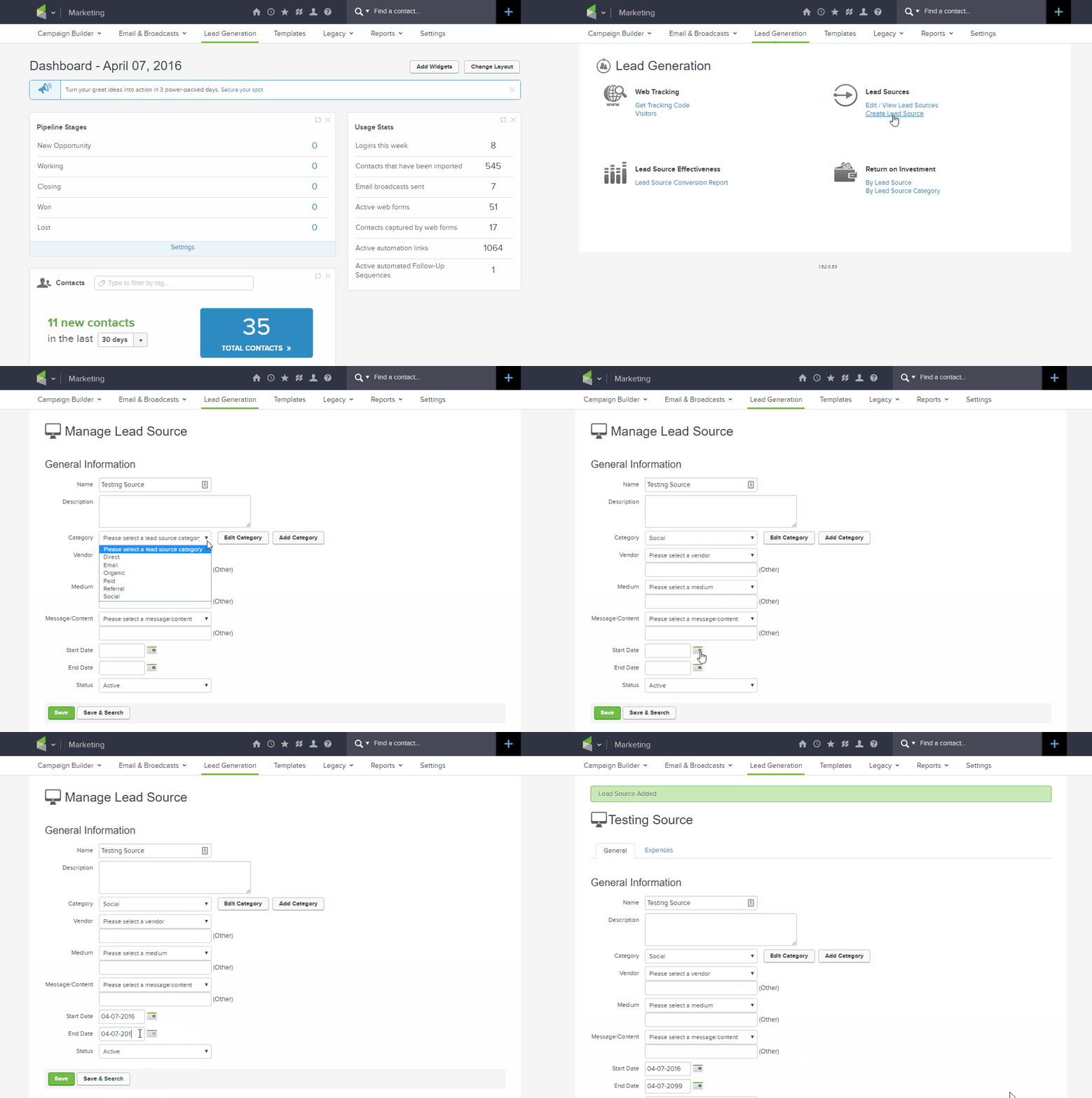
1) Creating a lead source –
From your dashboard:
- Click Lead Generation
- Click Create Lead Source
- Complete form & save
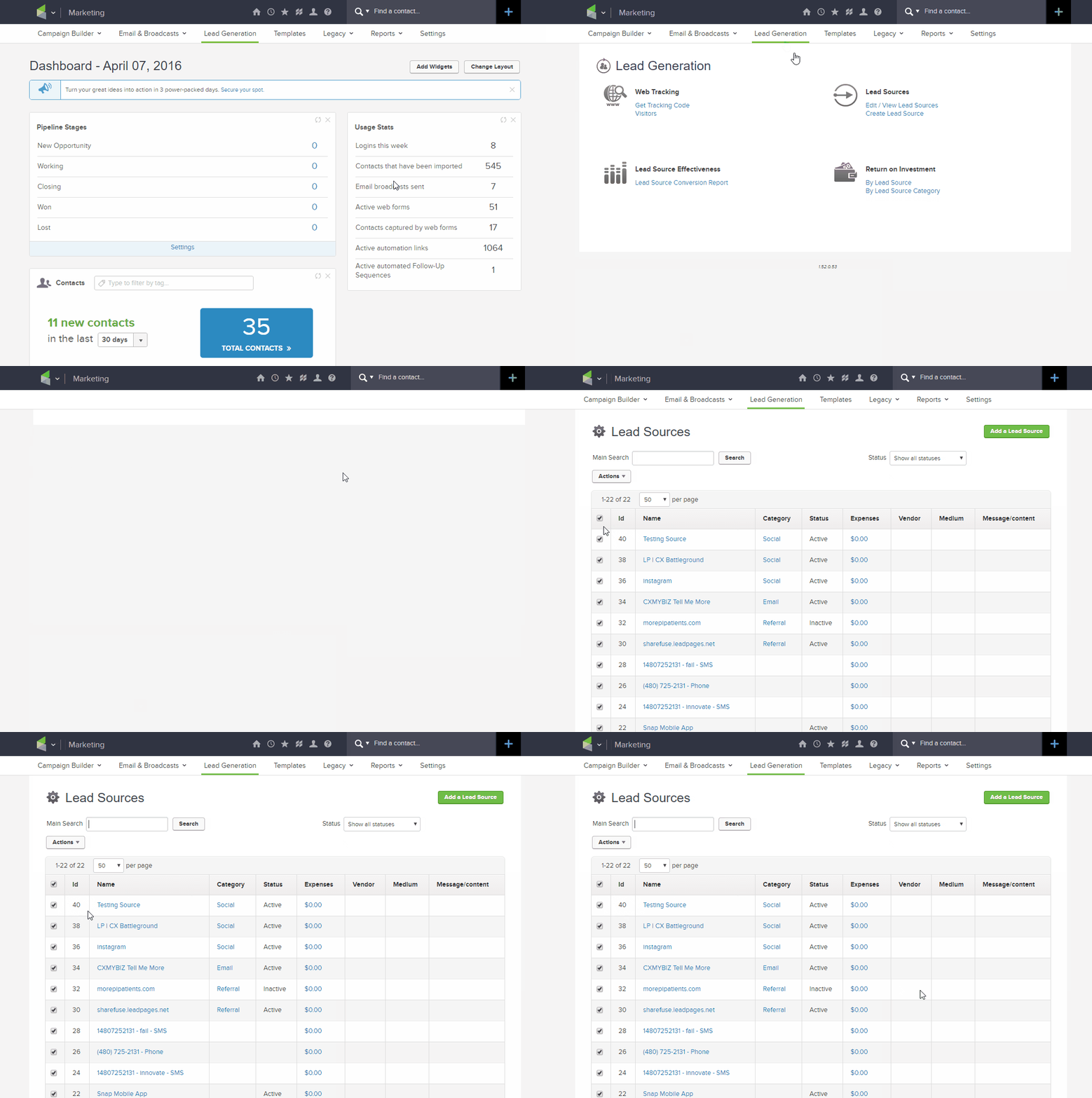
2) View the Lead Source ID-
From your dashboard:
- Click Lead Generation
- Click Edit/View Lead Source
- Identify the ID of your Lead Source
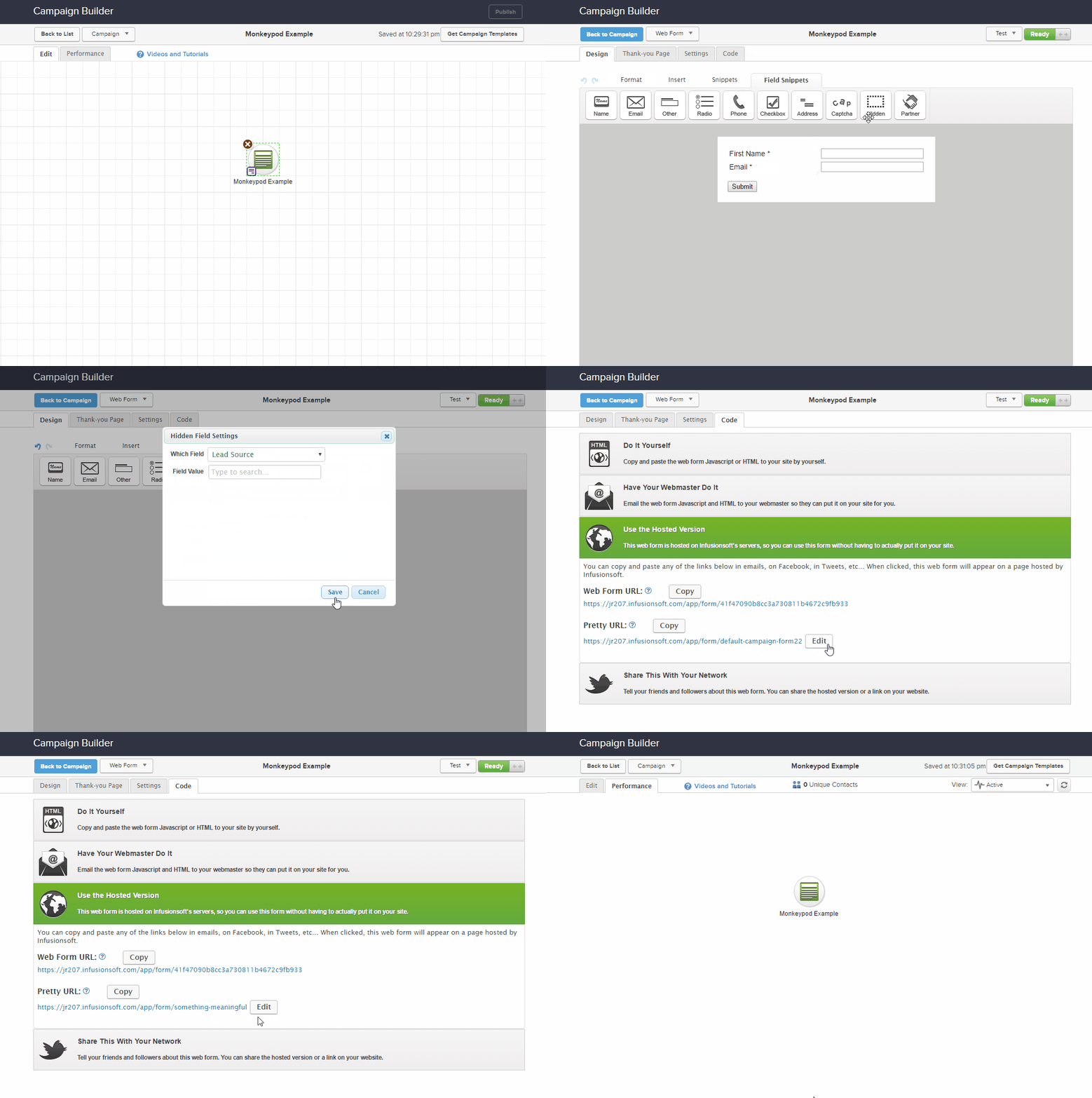
3) Drag a Hidden Field onto your Webform then copy the Pretty URL-
From within the Automation Builder:
- Create a webform
- Drag out a hidden field
- Select the Lead Source option
- Rename & Copy the pretty URL from the code tab.
- Publish the Form
4) Create a link to point to the webform and attach the variables to the URL-
- Paste the URL:
https://jr207.infusionsoft.com/app/form/something-meaningful
- Add your ? to let the page know there are variables in the URL:
https://jr207.infusionsoft.com/app/form/something-meaningful?
- Add your variable and assign its value:
https://jr207.infusionsoft.com/app/form/something-meaningful?LeadSourceId=40
Paste this URL into your ad copy (feel free to shorten or customize it as needed):
Customized: Click Here
Shortened: https://bit.ly/my_Link
That’s it! Run a few tests on the lead sources. Change up the ID’s to other sources in your LeadSource table and verify that it is assigning them appropriately (TIP: Use a new test lead each time…as this process will not overwrite an existing lead source).
The first few times, it may take you more time to set up as you commit the steps to memory.
IMPORTANT TO NOTE: For every traffic source or marketing campaign (Facebook, Twitter, Instagram, etc) you will want to have a SPECIFIC lead source so that you can tell where the leads are coming in from. Simply repeat the steps above to make sure that you create and capture the correct LeadSourceId.
If all of your traffic initially comes through the same lead capture webform, your URL will stay the same. Only the LeadSourceId will change.
Here’s an example for how you can track ROI from a Facebook Ad using Keap LeadSource tracking.
Keap, Tips and Tricks
I know that sometimes I can be a little long-winded when I write my blog posts, so today I’m going to get right to the point.
One way or another you may have wound up with contacts in your Keap database who don’t have a first name.
This can pose a challenge if you are using the first name merge field in your email content.
This video shows you how to find those contacts, how to manually fix a few of them – and how to set up a default for situations where the merge field doesn’t have a name on file it can use.
Enjoy:
Keap, Software Updates
It’s 120 degrees or so in Phoenix these days (or so I’m told), and everyone knows that when you can’t go outside you might as well work on the Infusionsoft July Update, right?
Well, regardless of the reason, the product team is pushing out another valuable release, and I figured I’d take a moment to share the highlights:
Feature #1: Sharable Dashboard Custom Statistic Widgets
 What it does: This allows you to configure a dashboard widget for one user, and then share it to other dashboards for your other users.
Why it matters: This is really valuable for accounts who have a lot of users, or for people who have a lot of Infusionsoft accounts (ICPs, VAs, Partners, etc).
Here’s the deal – you’ve always been able to create saved searches and give other people access to those searches.
But in the past, they had to know where the search was in order to go access it. And if they wanted to add it to their dashboard, they had to know how to add a widget, and then how to configure that widget to give them the information that they wanted.
Not anymore.
With this update you can configure a custom statistics widget (RIP Lil Box O’ Stats) and then once you’ve got it just so, you can push that widget (stats and all) through to the dashboards of other users. Giving them all of the reporting insight, and none of the effort of configuring it.
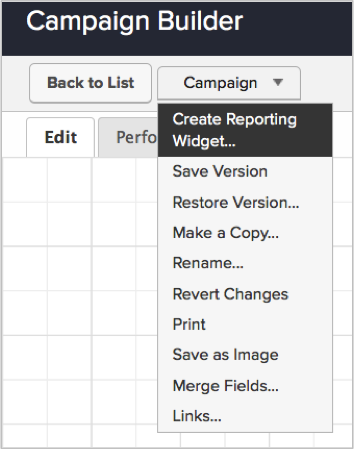
Feature #2: Create Dashboard Widgets to report on Campaigns
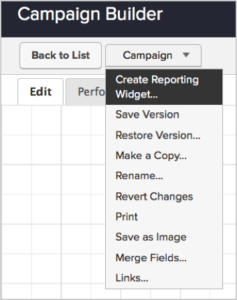 What it does: This allows you to quickly and easily create a widget on your dashboard to give you a handful of statistics from your campaign.
Why it matters: This information has always been available to us, but in order to access it you had to use the performance tab in your published campaign, or you had to create the report from scratch under the Marketing>Reports section.
Not anymore.
With this new release Infusionsoft will automatically choose 5 goals (goals only), and will a widget to your dashboard telling you exactly how many people have achieved this goal in the last 30 days.
Caveat: Yes, I’m a huge Infusionsoft fan; but I also have really high expectations for them, and this particular feature is….a good idea. It is. I think this is a step in the right direction, but I don’t think it’s quite there yet. The good news is, if their recent track record of improving is any indicator, I think Infusionsoft will get there over the next few releases.  In order for this widget to really be usable, we need a few things to be added:
- I need to be able to choose the goals that I want to track. Most of my campaigns have more than 5 goals, and having the system determine 5 random goals isn’t going to give me the insight I need.
- We need to be able to adjust the date range. Right now it defaults to show you those 5 goals and their activity over the last 30 days. I’d like to be able to switch that to 24 hours, MTD, YTD, last 7 days, etc.
- We need to be able to apply additional filters to this report. Show me how these goals are performing for those who don’t have the “customer” tag. Or who are assigned to Greg and not Craig.
- Right now it only draws goals that are exit points, or entry points. I’ll definitely want to be able to measure important milestone goals along the way.
- Finally, why isn’t this widget sharable? I mean, forgive me, I’m not a developer – but if you’re busy coding up a new widget. And you’re also busing coding up the ability to share widgets. It seems like maybe we’d be able to share the new widget. Please?
Like I said, good step in the right direction. I’m looking forward to seeing where it goes from here.
The other big features that they’re releasing with this update have to do with the beta email builder.
- They’re allowing you to select legacy templates now when you want build an email, and as you bring that template into the email builder it will automatically convert the legacy elements to the new mobile responsive equivalents. It won’t be an exact translation, because not everything from legacy has a 1:1 counterpart in the new builder, but it should be pretty close.
- In that same vein, you’re now also able to convert existing emails over to the mobile responsive beta builder. Yup, that means if you have hundreds of emails you’ve built and have been using, and you’d like to convert those over to mobile responsive emails, you don’t need to rebuild everything. You can use the converter tool to migrate the old content into its fancy new home.