Adding Brand Character

Adding Brand Character

I’m noticing a trend in marketing lately – brands are actively looking to new ways to distinguish ourselves.

Well, distinguishing ourselves isn’t new – but doing it with animation and gifs might be.

Wait, gifs?

Yes, Graphics Interchange Format files – those gifs. (Though, until today I thought it stood for “Graphic Image Files”, oops.)

They’re not quite videos, but they’re so much more than just images.

And I think they miiight be my love language.

If you’re thinking gifs are silly little internet fodder, I totally get that – they kinda are.

But if you’re thinking that they have no place in business, then allow me to challenge that.

They’re a great way to add a dash of ‘character’ to your business.

They let us add a little bit of movement to our marketing – and this simple form of animation can help with engagement, it can enrich the way we’re communicating, and it can add a sprinkle of personality to our brands.

(psst, those are all good things)

But if only we had some examples, right?

Examples of GIFs in Marketing:

Here’s a simple example from a WP Engine email I received recently. (Look closely, it’s subtle.)
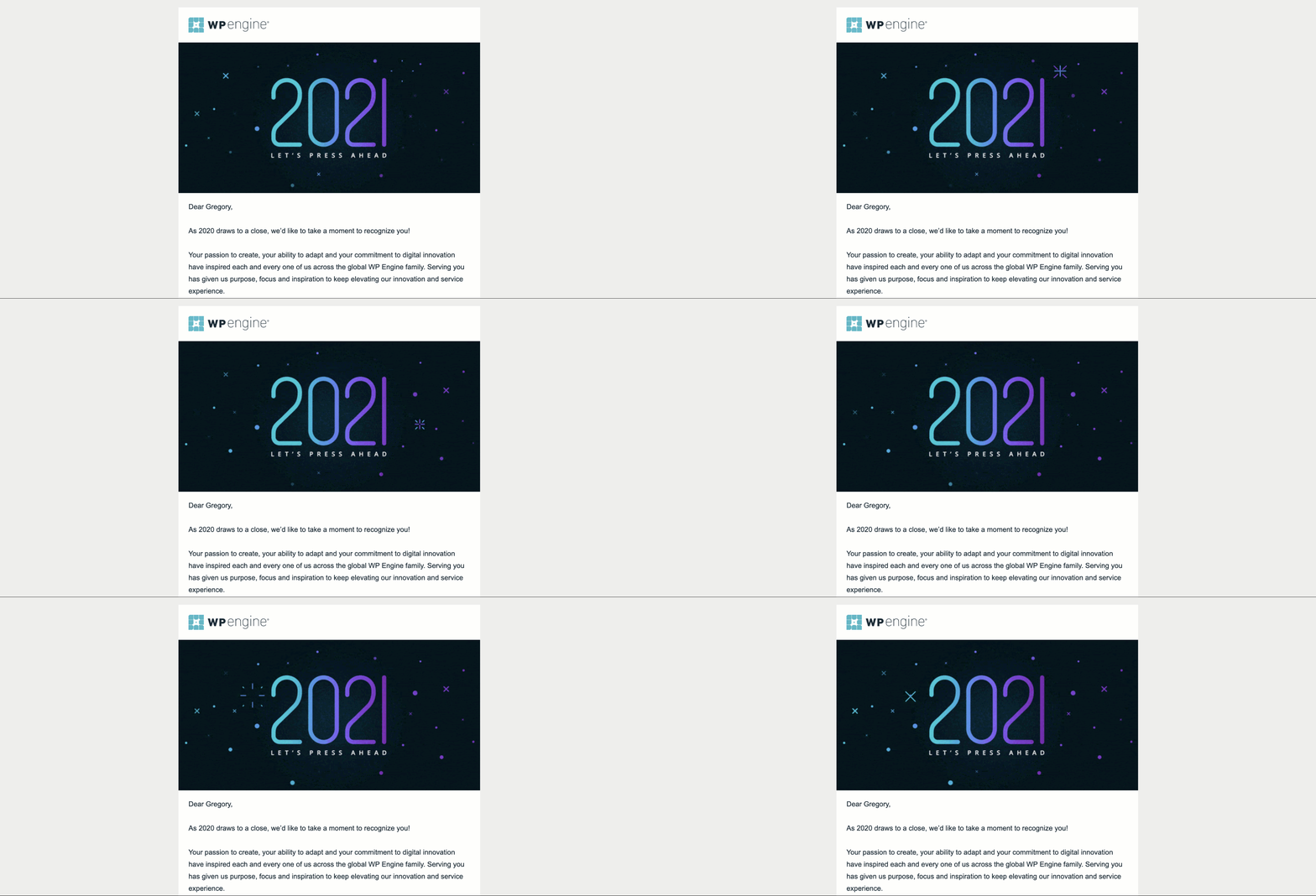
Nothing crazy – but the light sparkle they’ve added to their email header adds a touch of excitement – without feeling over the top.

Here’s another clever visual example from an email Moo.com sent me letting me know they’d delivered my order.

Moo Delivery GIF

As I’ve been seeing these gifs in the wild, I’ve also started noticing opportunities to use gifs in my own marketing.

Here’s an example of a gif I created to help celebrate someone completing one of my courses:

TOC progress gif

But emails aren’t the medium gifs can be useful – they can be a fit for landing pages, blog posts (like this one), thank you pages, or anywhere you’re visually engaging with your prospects and customers.

Here’s a simple set of gears turning on the thank you page after someone requests access to one of my mini courses.

gears turning gifs

I know that adding fun or engaging graphics throughout your marketing might feel a bit extra – superfluous even.

But details like this can be the difference maker that helps your brand stand out.

In a world where consumers have unlimited options – our decisions are guided more and more by the brands that resonate with us.

Let’s ask an expert:

I asked my friend Mychal about this concept – and the role that visual differentiation can play for a business.

For context, Mychal has been growing a boutique animation agency, Folklore Creative, over the last few years.

Here’s what he had to say:

“What is “visual differentiation?” To me, it’s a feeling we get, very rarely when we visit a piece of content and it creates an emotional reaction purely based on looking at it. These emotions can be anything at all.  Soothing (imagine a cloud floating by), shocking (imagine an unexpected lightning bolt strike or a baseball crashing though a window), humorous (imagine a baby tipping backwards on a comfortable couch), or even cute (see headspace’s characters as an example that we modeled our brand after).  

By creating brand related character or very literally characters, you can help associate your brand with one of our most relied upon senses, sight.”

I love how Mychal zooms out on this – it’s not just about gifs, but about differentiating ourselves visually.

Here’s an example of the Headspace animated characters Mychal mentioned:

And you can check out all the use cases on the Folklore site, but here’s an example of the characters they’ve used throughout their brand:

gears turning gifs

I’m sure you can think of countless examples of bigger brands using characters in their marketing – but this approach can translate to small business too.

How do I get started?

The easiest way to get started is by using gifs where you feel they make things clearer or more fun.

I’m not saying everything should be a gif – but that in select instances they can help us communicate more clearly, or add a layer of personality.

You can use existing gifs, or create your own using an app, like Giphy Capture for mac – or, by exporting a short video as a .gif file.

Creating GIFs w Camtasia

That’s v1. And if you want to take things to the next level, you could design a theme that adds consistency to the animations you use throughout your business.

I asked Mychal for an example, and he served up a few versions of this shark guy, a character his company designed for one of their clients:

shark trio

And then a further evolution on this might be creating formal animated videos for your brand – either explainer style (like this one), sales videos, or tutorials that serve your customers.

Can I use GIFs in Keap?

Yes – you can add gifs directly to the email builder in Keap. There are two methods – you can either upload them directly (if the file is small enough), or you can host them on your own site, and use the hosted image location.
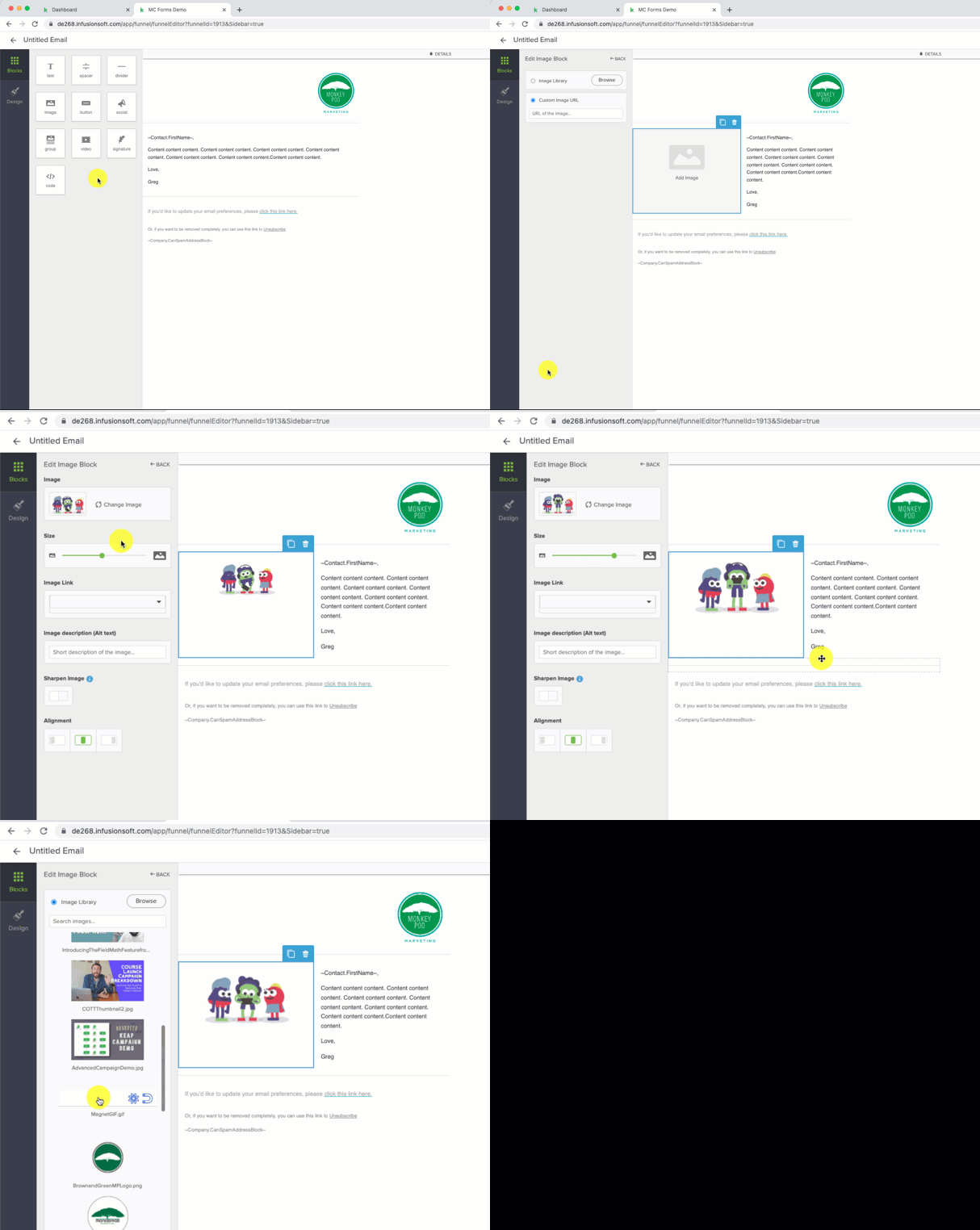
adding gifs in Keap

Takeaway Lessons:

I’ll summarize with three take-aways: find ways to set your brand apart.

1. Gifs are more than just fun eyerolls that we send to our friends (though, they’re that too).

They can help us make a point, or communicate in different ways – and clearer communication serves everyone.

2. Adding character (or literal characters) to your brand can add a layer of cohesion to your marketing, and be a powerful way to shape the way people think about your business.

3. We live in the most connected day and age there ever has been – and more and more, people want to do business with humans.

Adding personality to your brand, through copy, images, gifs, or animation will only serve to strengthen the connections you create with your audience.

2020 Year in Review

2020 Year in Review

2020 was…something else.

It was both the year I learned to take my mental health seriously, and the year I learned to cut my own hair.

And I honestly wasn’t sure if I was going to write a summary post because just making it through 2020 was an accomplishment.

That might be why we’re a month into 2021 and I’m just getting around to publishing this bad boy.

But I’m sharing for a few reasons:

  1. It’s still important to recognize and celebrate our progress – maybe especially so these days. Most entrepreneurs I know are constantly looking forward – but from time to time it’s helpful to look back at how far we’ve come.
  2. The 2019 recap I did last year was one of my most popular posts – and if this encourages anyone to do a recap of their own (private or public), then I’ll consider it a win.
  3.  And the final reason for this post is to shine a light on the people, projects, and tools that have helped me, just in case they help you too.

By the Numbers

I’m proud of Monkeypod, and my business did grow last year, but I’m probably not setting any records.

I decided early on that I wasn’t going to pursue growth at all costs – I care a lot about how it grows.

That said, I figure we may as well start with some numbers so you have some context for how things work around here, and so that I’ve got it documented for posterity.

In 2020 my website had 63,958 page views (56,053 unique).

2020 website stats

Last year was, as we all know, not a normal year. COVID had an undeniable effect on the world, and by some measures the small business community was among the most vulnerable.​

I point that out because these numbers are actually lower than they were in last year (in 2019 my site had 67,231 page views, 58,968 unique). I call that out because the goal of this recap isn’t to impress anyone, it’s to share an honest look at how things went last year.

As with before, the bulk of this traffic was driven by content marketing, with small percentages coming from paid Facebook and Instagram traffic, and affiliate promotions.

I also engaged an SEO company, Headflood, to help with optimizing my site – and I suspect my traffic would have taken a serious nosedive had it not been for their assistance.

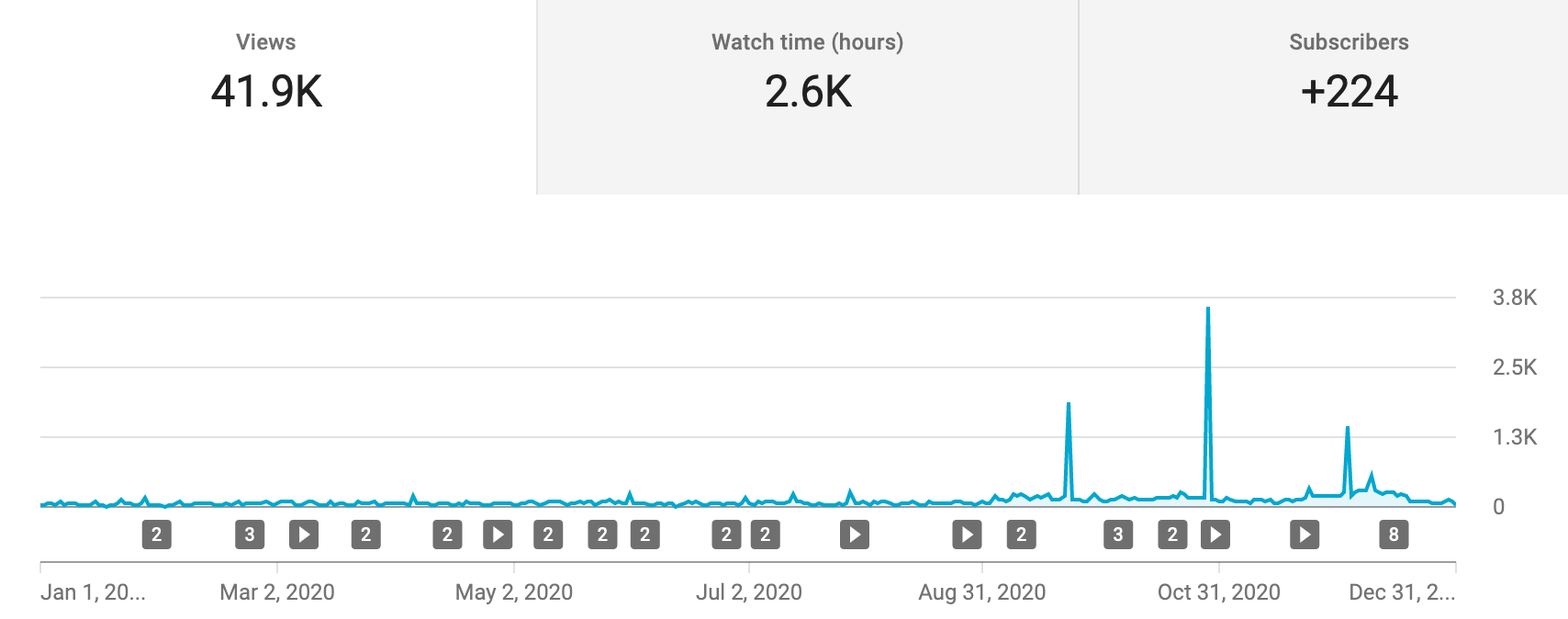
Throughout 2020 I continued to focus on creating content for my YouTube channel – which yielded more views, and an increase total watch time.

2020 YouTube Stats

For reference – these numbers are all up over 2019’s stats.

Approximately 9k more views, 28 more subscribers, and double the watch time.

That last one blows my mind a bit – in 2020 you guys spent 2600 hours watching Monkeypod YouTube content.

OG Membership

I’ve said it before and I’ll say it again, the OG Membership is my favorite part of my business.

I had my share of struggles in 2020, but the OG group was a constant source of validation, purpose, and inspiration for me.

Growth wise, I’m happy to report that in 2020 we added 4+ new members a month (52 for the year).

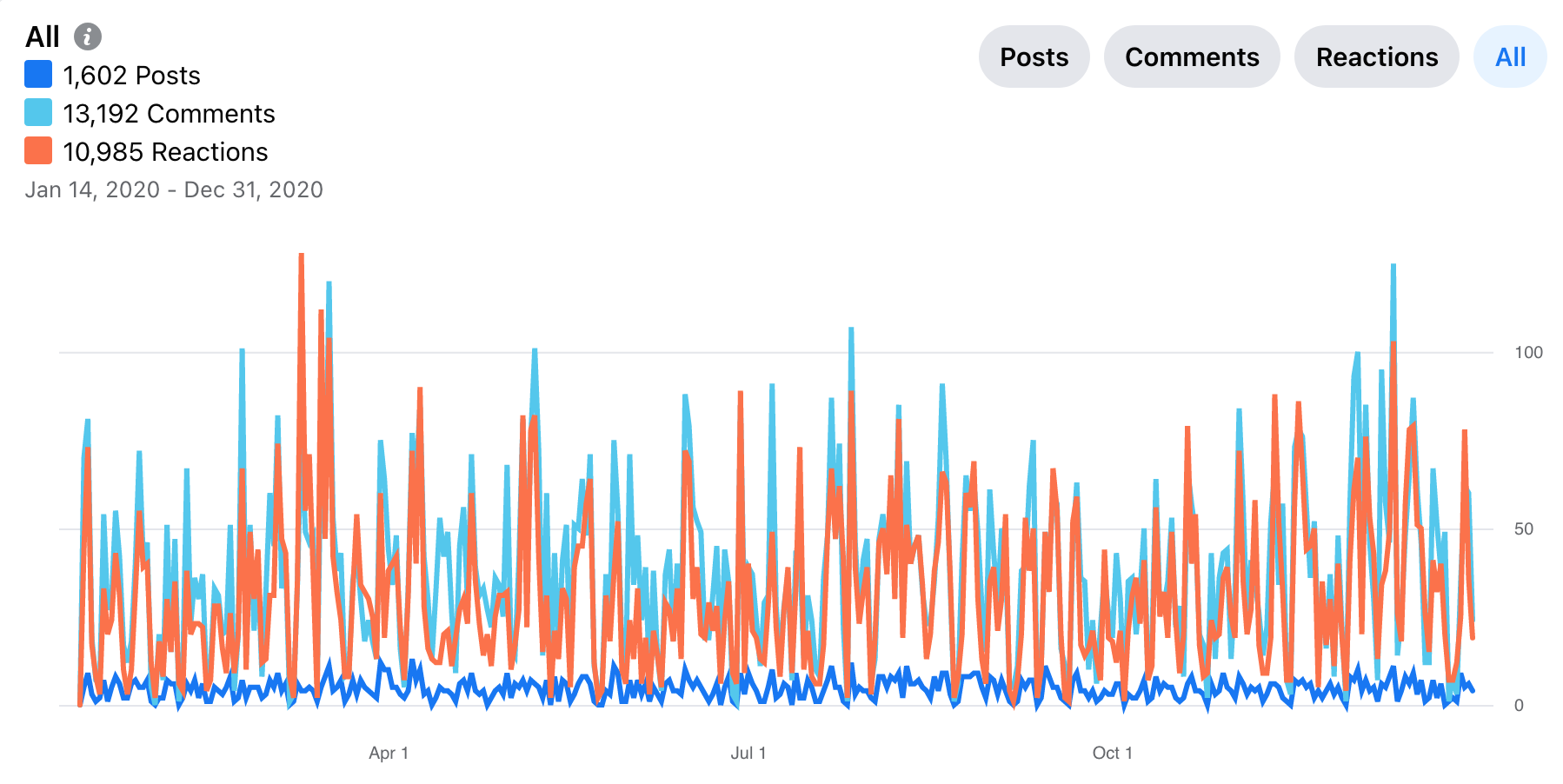
The membership has a handful of benefits, but at it’s core is our Facebook group where 1,600 posts were started, accumulating 13,000 comments.

2020 OG engagement

No sales pitch here – but if you are interested in the OG group then check out the membership details here.

Accomplishments

Again, surviving 2020 was an accomplishment on it’s own, so if you didn’t feel as productive last year as you like to be then please give yourself some grace.

It’s not fair to compare it to typical years because 2020 was not typical.

That said, I still sat down to comb over my calendar and see what I spent my time on. Here’s a list, in no particular order, of some of the bigger accomplishments from 2020:

1. Launched The Infusionsoft 101 Mini Course

A little ironic that I’m celebrating this now, because any day now Infusionsoft will be renamed, and while the advice in this mini course will still be valuable, it will feel less relevant because they’re retiring the “Infusionsoft” name.

There were 212 registrant for this mini course last year, and 185 (87%) of those registrants started the course, and 78 (36%) completed it.

Infusionsoft 101

This free mini course was designed as a follow up to the Marketing Automation 101 course – it follows the same montage interview style format, offering high level advice and best practices for thinking about and adopting Infusionsoft.

If you’re interested, you can check it out here.

2. Relaunched the IS Starter Kit Course

When COVID really hit the US and we went into a clear lockdown my anxiety rapidly built.

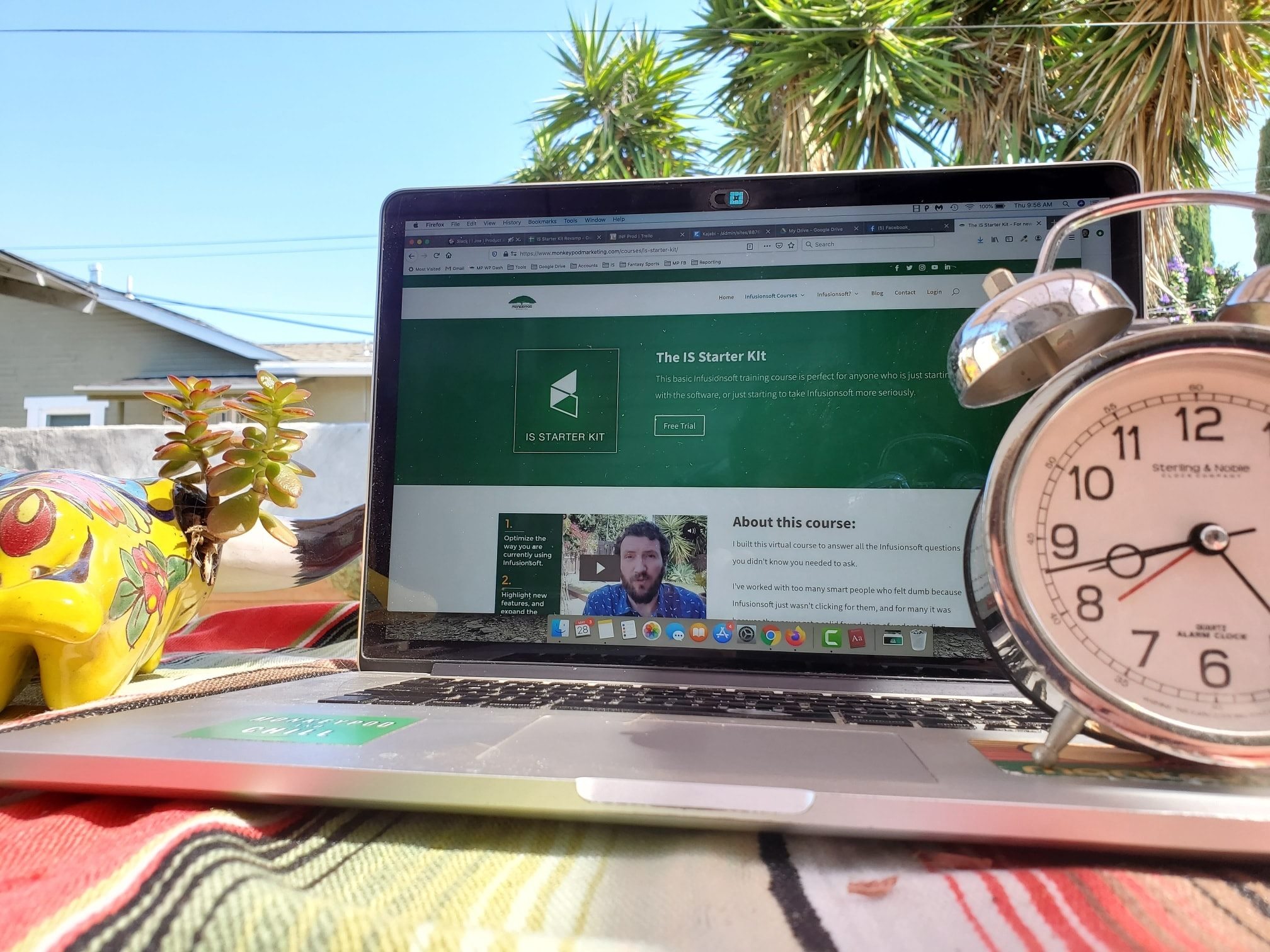
I tried to keep my mind occupied by updating the IS Starter Kit course – as I was re-recording a few modules, I decided to rerecord the entire thing.

starter kit countdown

I’m really proud of how the new version of the course came out – it truly was bigger and better in every way.

I did a full re-launch once it was done, and recorded this short video recapping some of the lessons I learned and four tactics I used.

3. Hosted Tribe-pod Study Group

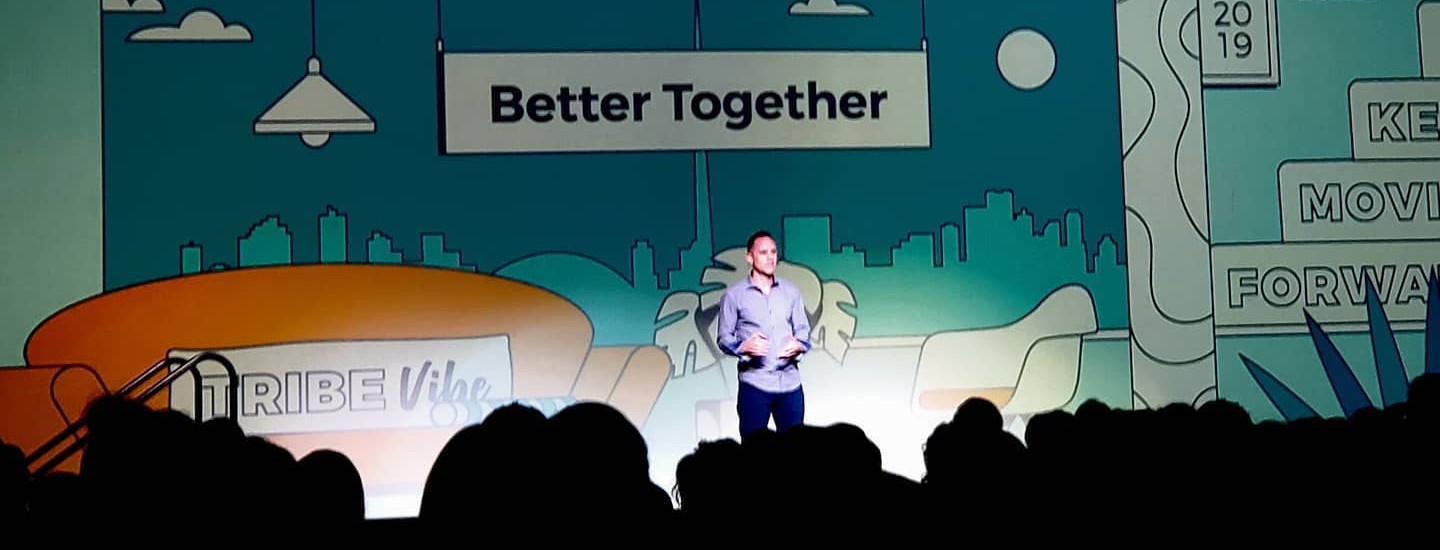
In 2019 I was introduced to Tribe (thanks PJ and Suzi), which is a powerful course from Stu McLaren on memberships and membership model businesses.

Stu at Tribe Live

Well, in 2020 I not only joined Tribe again – but I also formally promoted it.

And then I hosted a weekly study group to share ideas and brainstorm as we went through course experience – special shout out to Brian Keith for his help organizing and moderating our zoom pow wows.

If your business has a membership, or you’re interested in one then totally check it out, I think registration opens in April of 2021. In the meantime, here’s a guide of theirs you can start with, and a blog post of mine highlighting some of my biggest lessons.

4. Hired an OG Community Manager

Perhaps the smartest decision I made in 2020 was hiring Jade to act as the official community manager for the OG Membership.

Jade was an Infusionsoft user, and Monkeypod Member, and in early 2020 she left her full time job and started her own agency.

Her humor, personality, and small business expertise made hiring her to help support the OG members an easy choice.

Jade

In August I registered her for Tribe Live 2020, and during the 48-hour event she wound up designing and launching a membership of her own.

She recapped her highlights from the event here.

5. Built and launched the OG Directory

I love connecting people, so adding a directory to my members area has been on my to do list for a while.

Webinar snapshot

Big shout outs to Mallory Balnis and Jason Oesterly, both of whom I hired to help with different aspects of this project.

6. Hosted a Copywriting Workshop with Sam Bennett

Sam is a personal hero of mine – and one of the most likeable people I’ve ever met. So it was an absolute privilege to host a workshop with her at IKON in 2020.

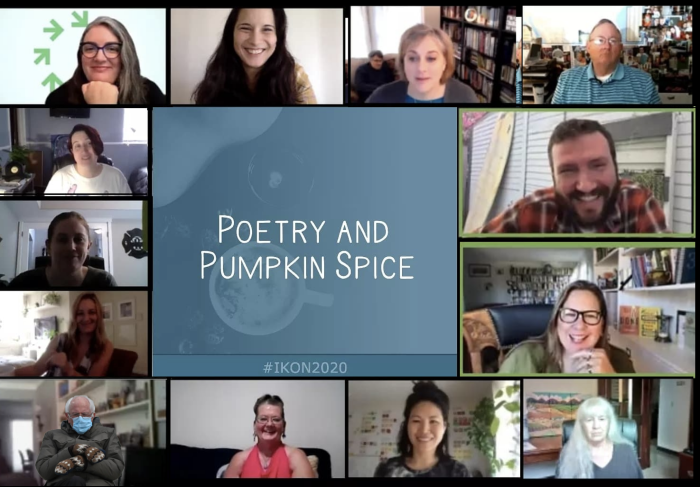
Poetry and Pumpkin Spice

Sam is terrific.

And our workshop, Poetry and Pumpkin Spice, covered some of our tips for writing emails you can be proud of, and that your audience actually enjoys reading.

If you’re interested in the slides and resources we gave away during our preso, you can download them here.

7. Launched Lifecycle Marketing course for FUEL

This was a high level approach to Lifecycle Marketing, what it is, why it matters, and how it affects small businesses everywhere.

You can check out the free video series here.

Webinar snapshot

This course, and the FUEL brand, were an exploratory project. The mini course is valuable (and you can totally check it out), but the project is on hold for the time being.

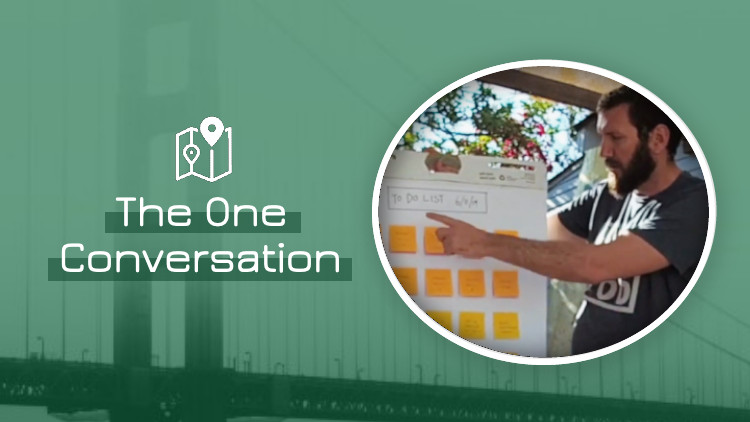
8. Launched The One Conversation Mini Course

This video series is titled “The One Conversation” because it is the conversation I would have if I were consulting with any small business on the planet.

Webinar snapshot

The mini course follows a conversation designed to help any small business evaluate (or design) their Customer Journey, and then identify and prioritize the opportunities they reveal.

You can sign up for it here if you want the full experience, or I’ve also got the videos unlocked in a YouTube playlist as well.

Content

Make no mistake, producing content is a lot of work – but it’s also the type of thing that gets easier as you practice.

My advice to anyone who asks is to treat content like a muscle – it gets stronger as you exercise it, and it atrophies when you don’t.

As proud as I am of the various accomplishments above, the truth is that I spent far more total time and effort writing blog posts and recording video content for my various platforms.

In 2020 I published 19 blog posts and 43 YouTube videos. Candidly, those numbers were both down from 24 and 50, respectively, in 2019; but I’m cutting myself some slack because as we’ve discussed, this wasn’t a typical year.

Top blog posts from 2020:

  1. So, you want to launch an Online Course?
    This is an outline I created for designing, recording, and launching an online course
  2. Reaction vs Response
    This is a guest post from my good friend and favorite rising philosopher Justin MacDonald, where he talked specifically about the difference between reacting, and responding
  3. Marketing Automation Myths
    This blog post unpacked three relatively common misconceptions I’ve heard with regards to marketing automation

Top YouTube Videos from 2020:

  1. Create Your Customers (13:43)
    Yes, you can absolutely target people who are a good fit for what you offer – but, I believe you can also create your own customers
  2. Start Using Dynamic Content Today (7:35)
    I still contend that dynamic content is the most powerful feature we’ve seen released since the campaign builder itself – here’s how you can start using it
  3. Tap into your Competitor’s Traffic (9:12)
    This is a quick trick my friend Brett Fairbourn shared (that he learned from Neil Patel) which can help you increase traffic on your site

If you’re here, and you found any of that valuable, then I’d recommend subscribing to the the Monkeypod YouTube channel and, if you haven’t yet, subscribing to this blog.

Personal

This section of last year’s recap was actually titled “Travel”, but for obvious reasons, 2020 didn’t feature nearly as much travel as we would have liked.

So I figured I’d use this section to share a few personal updates.

First, and as I’ve alluded to, 2020 was the year I learned to pay attention to my mental health.

I know COVID effected people in a wide variety of ways and in varying degrees of severity, but for me personally, I really struggled with anxiety and stress.

It affected me in a number of ways.

Personally, it looked like difficulty sleeping, and I found that I was generally less patient, and more irritable.

Professionally, I struggled to stay focused. I found that I needed to take more breaks, and I was easily overwhelmed. Little obstacles that I normally would brush off felt insurmountable.

The funny thing about mental health is that these things are all pretty understandable – and forgivable when you’re looking at it rationally. But when you’re not, then you start to get dissapointed with yourself, and the issues compound themselves.

I can’t count the number of times that I reminded myself “It’s not fair to compare your performance or drive to other years, the circumstances are different; and you are different.”

But as much as I know and believe that, it’s still easier said than done.

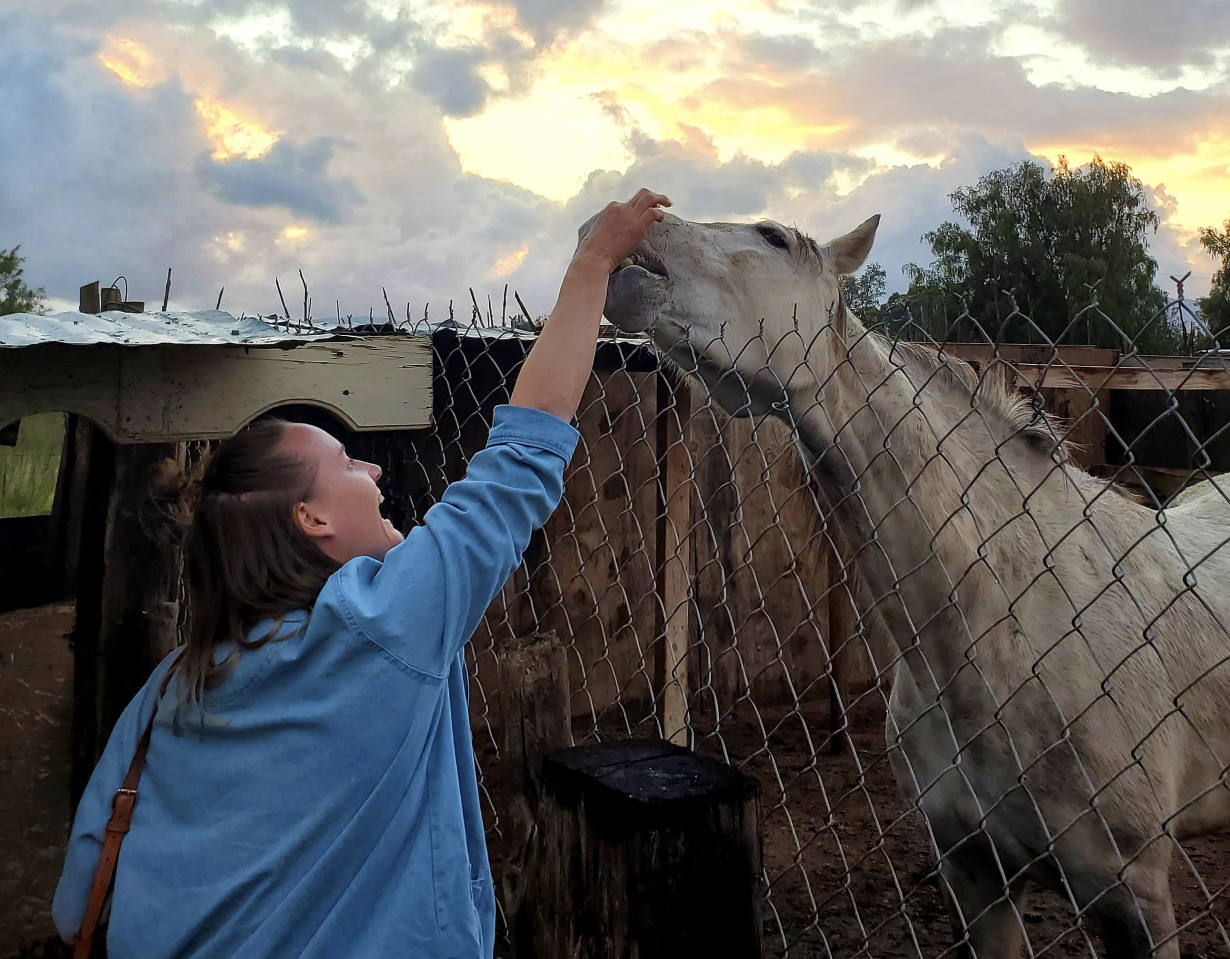
There were a few main support systems that I relied on to help me last year – first, Sara. She’s the best.

Sara has been my partner for almost exactly a decade now. She often believes in me more than I do myself, and last year I depended on her more than ever before.

Sara feeding Horse

And second, was the Monkeypod community. Yes, the OG Membership, but also everyone on my list, or in my network.

There were countless times when I just simply didn’t feel like writing an email, a blog post, or recording a video.

But more often than not, I talked myself into it because of the pride I get from serving you all. So, thank you.

The other coping mechanisms I pursued were exercise, and dogs.

I’ve always tried to stay active – but in 2020 it became an essential outlet for me.

According to my Strava app, I was active for 275 hours across 315 days, and walked, ran, or hiked 1110 miles.

Mt San Jacinto
Strava Stats

Climbing 65k ft of elevation seems…absurd. But like I said, hiking became a regular source of escape for us, so if Strava says that’s what we totaled, then who am I to argue.

Greg and sky

Relocation

In April Sara accepted a new position with CSU East Bay, which meant we’d be moving up to the San Francisco area. Shortly afterward it became clear that COVID wasn’t going anywhere, and that everything would be online for the foreseeable future, which meant we didn’t need to move immediately.

Our initial plan was to ride it out in San Diego, but 2020 laughed at our “plans” and quickly dealt us some unforeseen circumstances and we found ourselves looking for new housing in October.

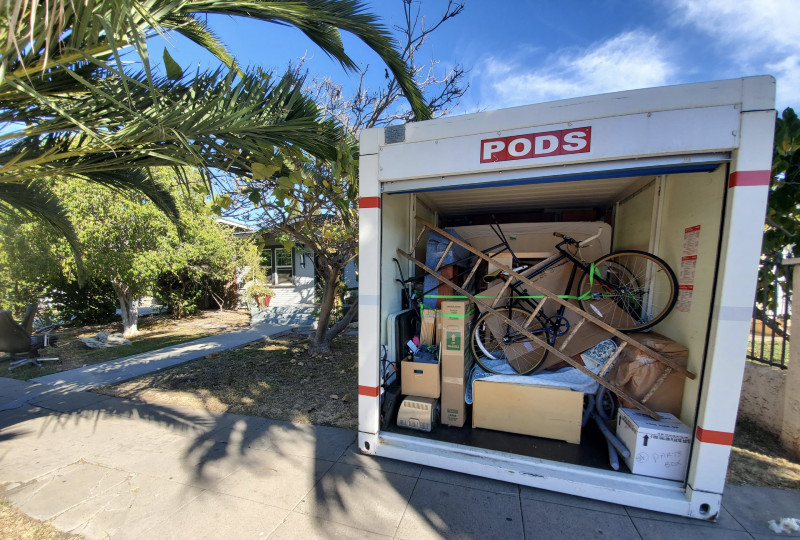
A good friend let us use her place in November (shout out to Ronnie), and then we moved up to Reno, Nevada for a longer-term-but-still-temporary stay while we plot our next move to the Bay Area.

These moves are exciting, for a few reasons.

Moving Pod

We love the San Francisco area, and we’re excited about this new role for Sara; but they also meant leaving our home and network in San Diego, which wasn’t easy (especially after 10 months of not seeing anyone or going anywhere).

It also meant leaving the Monkeypod Worldwide HQ, which prompted me to record this 54-minute silent video memorializing the backyard Monkeypod has called home for 5 years.

Dogs

Now, as many of you know, we lost our senior Australian shepherd Gatsby in January of 2020. It was difficult, but he had a long and happy life, filled with adventures.

We started to fill that gap by fostering dogs.

To be clear – Sara did literally all the work, and I just cuddled them from time to time; but throughout the course of the year we hosted 7 foster dogs.

Here are a few of our guests:

Sophie Foster
Zen Foster
Roomba Foster
Rosa Foster

Not that we need any more sad news, but in the interest of full disclosure, we actually did adopt a cute cocker spaniel in August, but after only a few weeks Frances went into kidney failure and rapidly declined.

2020, eh?

That said, dogs are the best. And fostering, though it had some challenges, was wildly rewarding.

Shout Outs

Last year I wrote “The longer I’m in business the more I realize how many people I depend on.”

And this year that was as true as ever.

I’m beyond proud of Monkeypod, but I also know that it’s much more than just Greg Jenkins.

So, if you’re reading this, thank you.

Thank you to my new community manager and Monkeypod co-pilot, Jade.

Thanks to the Monkeypod partners, the OG Members, and to the Keap employees I regularly annoy with my thoughts and suggestions.

And to anyone who has read, shared, commented on, or recommended anything that Monkeypod puts out.

It all helps, and I appreciate you.

Read This

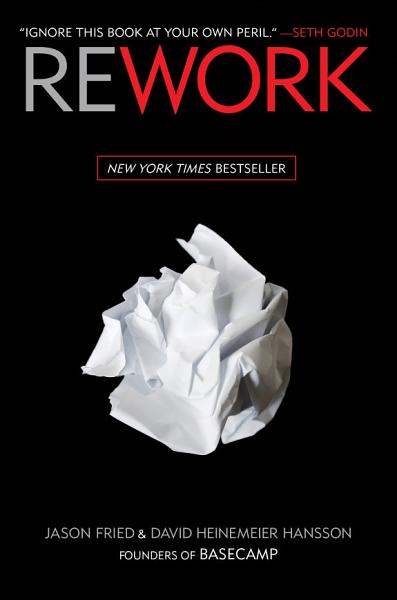
I mostly read fantasy to relax last year (any Stormlight Archive fans?), but for business books I want to strongly recommend Rework.

It’s a collection of business lessons from the founders of Basecamp. The lessons were profound, and the modular format made it easy to pick up and put down.

Rework Book

Listen to This

Last year I gave a shout out to two podcasts I dig, and they’ve both continued to be part of my regular rotation in 2020:

  1. Red Beard Radio (Listen)
  2. All Systems Go (Listen)

In the interest of transparency, I do know Brian and Chris, the voices behind these podcasts but I’m recommending them because they’re good.

Grow Here

I believe in education as a vehicle for personal growth, plain and simple. Here are three courses I completed in 2020:

Tribe log

– In 2020 I participated in Tribe again, and was impressed, again. If you have, or want, a membership offering in your business then start with this free guide and then take a look at Tribe when registration opens in the next few months.

Business Made Simple

– I checked out the Marketing Made Simple course from Don Miller (author of StoryBrand). His reputation is stellar, and his courses are no exception. He has a variety of topics worth checking out if you’re looking to improve your website, your messaging, or a handful of other topics.

YouTube For Bloggers

– I have followed Matt and Moneylab for a long time, because I like his voice, and respect the way he approaches small business as an experiment. So when he launched “YouTube for Bloggers” as a course, I figured it was time for me to give him money.

2020 Goals Recap

Man, another lesson that 2020 taught me is to be flexible.

Yes, goals are important – but we need to be willing to recalibrate when circumstances change.

That said, here are the three goals I called out in last year’s recap post, and a quick update on how they went:

Goal 1: “I’m planning to launch two more mini-courses: with the goal of increasing my reach, and creating valuable free content that leads to my progression path of courses.”

Outcome: I’m pleased to say I did launch two mini courses, Infusionsoft 101 and The One Conversation.

—-

Goal 2: “This is the year I take SEO seriously: I’ve always produced a lot of content, but this year I’m going to get serious about maximizing its reach.”

Outcome: Well, I did hire an SEO agency, and we’re making progress. But transparently, I haven’t devoted as much focus to that project as I had hoped.

—-

Goal 3: “Rebuild and relaunch the LCM Real Life course: It’s my personal favorite course, and it’s due for an overhaul.”

Outcome: I decided to overhaul the IS Starter Kit course rather than the LCM course, but I’m calling this one a success regardless.

—–

What Next

As far as goals for 2021, well, I want to keep my expectations reasonable, but here are a few I’m forecasting:

  1. Last year I donated more to causes that I believe in than I have in the past, and it felt good. So I want to get more intentional about that being a normal habit of mine.
  2. I’m clearer than ever that the OG Membership is the core of my business, but I’ve always treated it as a secondary offering. I want to restructure a bit prioritize it and help it serve the people who can benefit from it.
  3. I would like to bring the Monkeypod Retreat back this year. In 2019 I felt like the retreat had really hit it’s stride, but then it was shelved in 2020 (as in-person gatherings were prohibited). I’m hopeful that I’ll be able to host a live version in 2021, but I’m also going to explore options for conducting it virtually.

I mentioned earlier that the FUEL project was currently on hold – it is, but I’m working on the next iteration of it, and should have an update to share pretty soon.

Alright – *deep exhale* – this was a doozy, so thank you if you’re still reading.

What’d I miss? Anything you’re curious about?

Infusionsoft is now Keap Max Classic

Infusionsoft is now Keap Max Classic

If you were at IKON (or PartnerCon) a few months ago then you might have heard some rumblings about Keap Max.

But if you weren’t, or even if you were, you likely have some questions.

The tl;dr version is this:

  1. New name. Same product. More innovation. (All products are going to continue improving)
  2. Keap is unifying the product, brand, community. (We’re all Keap users)

In this post, and the video below, I’m going to answer as many Keap Max namechange questions as I can.

First up – what is Keap Max?

Simply put – Keap Max, or just Max, will be the new name for Infusionsoft.

Technically it’ll be ‘Max Classic’, more on that in a second.

Two years ago, at the start of 2019, Infusionsoft the company rebranded entirely to Keap (details here), but at the time they decided not to change the name of Infusionsoft, the platform.

So Keap, the company, had two versions of software that they offered: Keap and Infusionsoft.

Keap and Infusionsoft

Since then they’ve evolved a bit and their offerings now look like this:

Keap Grow >> Keap Pro >> Infusionsoft*

keap infusionsoft progression

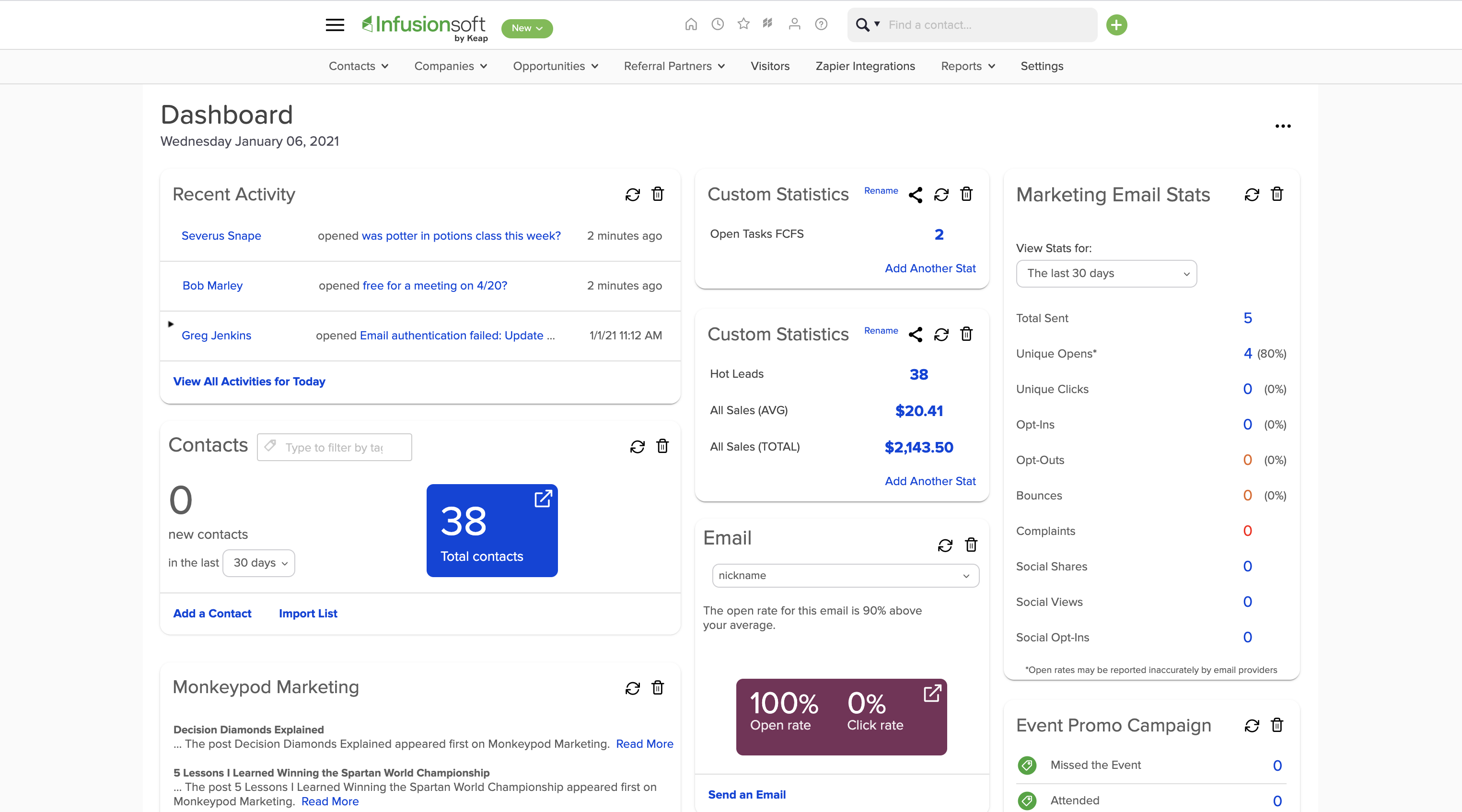
*for the last year or so, there have been two versions of Infusionsoft – the original, which looks like this:

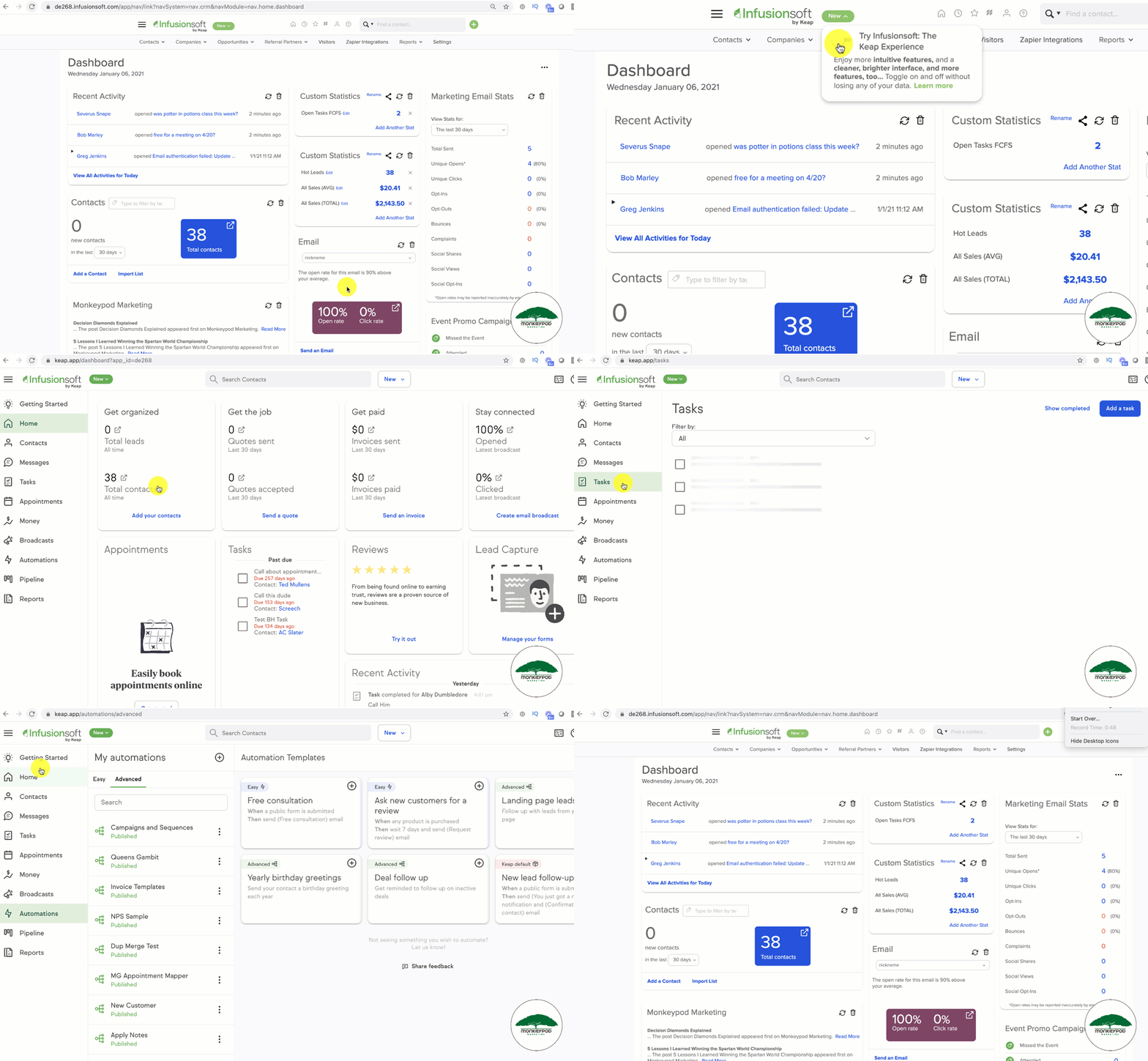
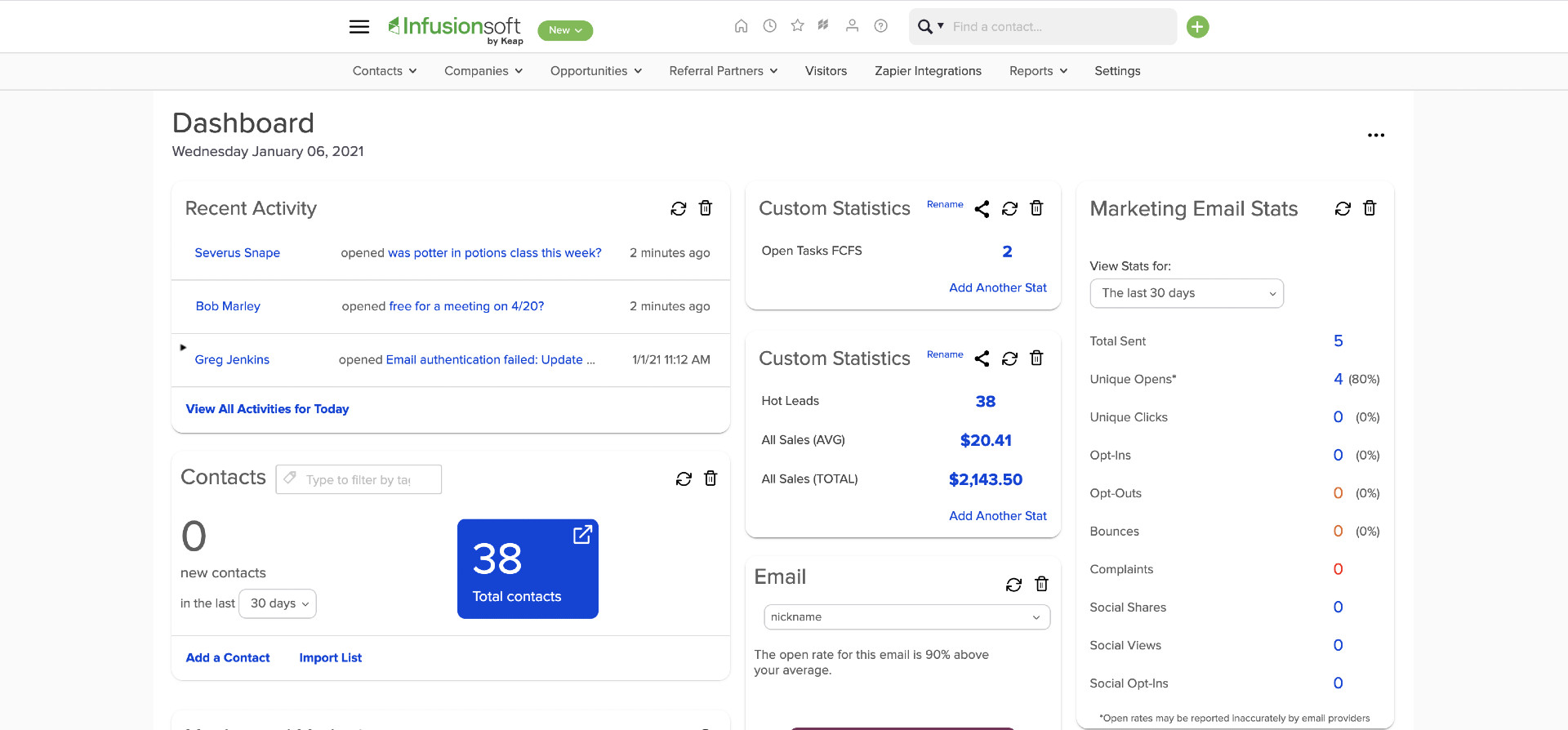
Keap Max Classic UI

And a version with a more modern interface, which looks like this:

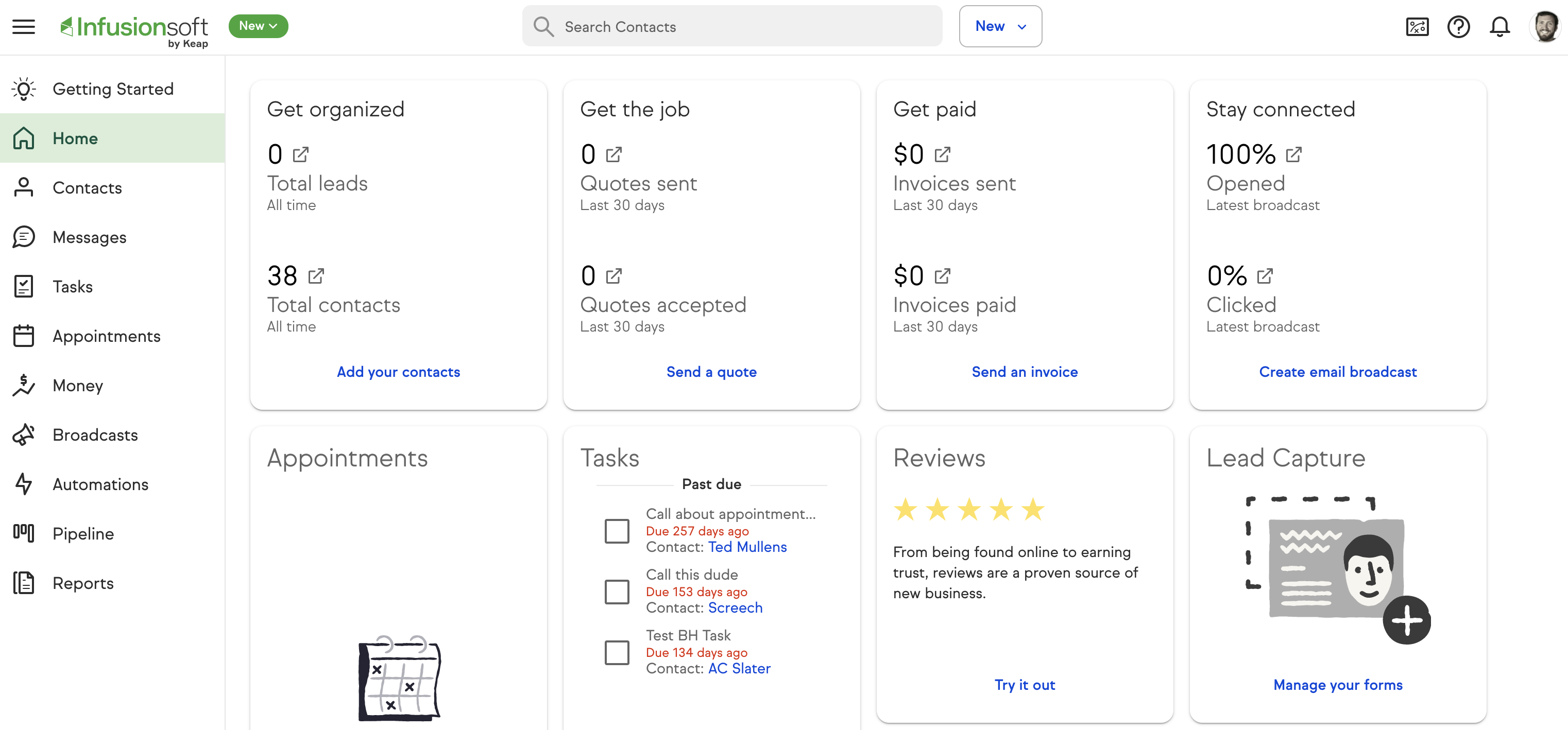
Keap Max UI

Most users don’t know that, because – well, because most people only use the version that they use.

The vision behind this product line-up was to create versions of Keap that serve entrepreneurs at every business stage and sophistication level.

Businesses can start with the lighter version, and more graduate onto the more robust versions as their needs evolve.

Why change Infusionsoft’s name?

Three reasons:

  1. Unifying the products
  2. Unifying the Keap brand
  3. Unifying the Keap family

Changing Infusionsoft’s name creates a clearer cohesion within the family of products that Keap offers.

Instead of Keap Grow, Keap Pro, and Infusionsoft, it’ll be Keap Grow, Keap Pro, and Keap Max.

Or, Grow, Pro and Max (which is more likely how we’ll refer to them).

As much as I love the Infusionsoft platform, the reality is that a name is just a name; and for new users signing up I can totally see why they’d want to create more obvious alignment between their offerings.

And I want to underscore bullet three on the list of reasons above – they’re working hard to strengthen the sense of community that our user base has always been known for.

So, Infusionsoft is now Keap Max, that’s it?

Sort of. There’s one more twist.

Remember how I said earlier there are technically two versions of Infusionsoft?

There’s Infusionsoft, the timeless beloved product that most of us know and love; and then there’s also a version of Infusionsoft with an updated interface and slightly different feature set known as “Infusionsoft on the Keap Experience”.

In fact, if you contact support you can have them enable a toggle that allows you to switch between the two interfaces:

Keap Max UI Toggle

The one known as “Infusionsoft on the Keap Experience” is going to be called Keap Max, or just “Max”.

And the original version of Infusionsoft is going to be known as Keap Max Classic, or simply “Max Classic”.

Support, development, and updates on both will continue as we’ve been experiencing, but their names will be changed to create a more obvious family of products.

What is the difference between Keap Max and Keap Max Classic?

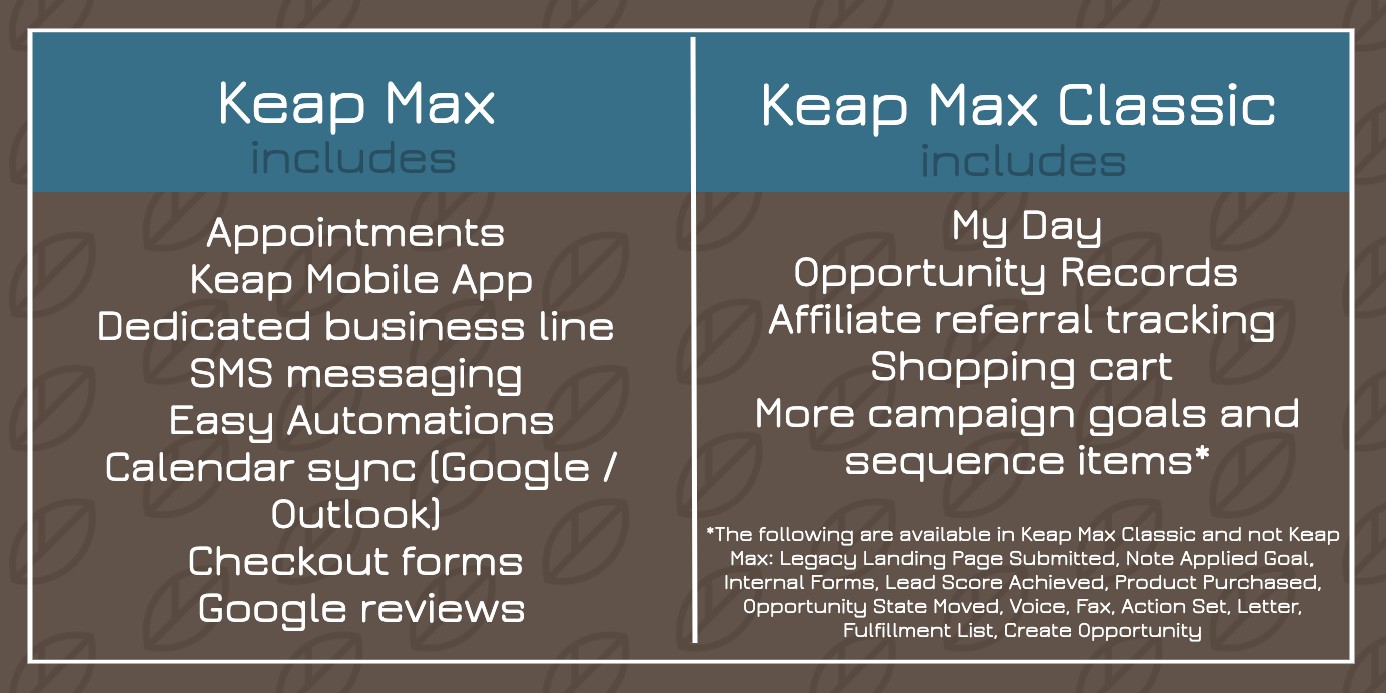
The two platforms have plenty of similarities, but each also have several features that are not available on the other.

Keap Max Classic is this one:

Keap Max Classic UI

Keap Max is this one:

Keap Max UI

Here are the key feature differences between Max and Max Classic:

Keap Max Feature Chart

You can find more detail on these similarities and differences in the Keap help article here.

Update: Max has received a few updates since the article I linked to was published, and it now does have goal types for Product Purchase and Lead Score Achieved. Thanks to Scott Martineau who offered some clarifying details in the comments below.

It’s also worth noting that as the products continue to evolve the current discrepancies will change (for example, I hear native text messaging is coming to the campaign builder soon).

native sms

How does this affect me?

Depending on who you are, it might not really matter to you much at all.

Neither the software nor the improvements to them we’ve been enjoying are changing – this is just a new name.

If you’ve been an Infusionsoft user, then you’ll switch to saying “I’m a Keap user”.

And if you need to clarify the version you’re using, we’ll say “I use Max” or “I use Max Classic”.

If you’re a Keap Partner then this might mean updating your website, or your various offerings so that you’re promoting Max and Max Classic services – rather than Infusionsoft.

This kind of change probably matters most to content producers who have a body of content that are using the term “Infusionsoft”.

For folks like us we’ll have to do some serious work revising our content strategy, and updating what we can (blog posts, videos, courses) to make sure things are kept as relevant as possible.

But for everyday purposes – this is just a new name.

Same product, new name, more innovation.

Should I be alarmed by the word “Classic”?

No.

I mean, it’s a fair question. I can’t blame you for asking.

But no – you can have confidence that they are committed and innovating on all products, including Max Classic.

If you feel term “classic” sounds a little unsettling, you’re not alone. I asked about that too.

The answer I was given is that we should think of it less like “Classic cars” and more like “Classic Coke”.

In other words, a timeless favorite rather than a discontinued model.

And if you’re still skeptical – trust me, I get it. Here’s what Clate Mask, CEO and co-founder, had to say:

Over the past year we’ve worked hard to reduce bugs, add new features, make deliverability improvements, and organize the company to better serve Infusionsoft users. We will continue to show our commitment every week with continued innovation in the product you and I love.

Clate Mask

Keap CEO and Co-Founder, Keap

If you have questions, ask them – the best thing we can do as a user base is let them know what we’re worried about, so they can respond directly to our concerns.

When is this change taking place?

Word on the street is that the new name(s) will go into effect in February. I’m sure there will be a handful of more formal announcements as this process unfolds.

The goal of this post was just to put it on the radar so we all knew it was coming, and can think through any relevant considerations.

Anything else?

One more thing – Keap Grow is being renamed to Keap Lite.

The product progression now looks like this:

good better best current

But again, we’ll probably refer to them more familiarly – as Lite, Pro, Max, and Max Classic.

My Two Cents

As always, they don’t need my permission to do anything – so the following is just my personal opinion. But hey, this happens to be my blog, so here we go:

“Keap Max Classic” wouldn’t be my first choice for a new name, but I do think that renaming Infusionsoft is the right thing to do.

That isn’t easy for me to say.

I am or was an Infusionsoft employee, shareholder, user, and partner.

The company and the software have changed my life – and I, like many others, have a fair amount of emotional capital invested in the name “Infusionsoft”.

But the truth is that I’ve noticed a divide in the ecosystem ever since the rebrand. It has felt like the community fractured into two groups – those on Infusionsoft, and those using Keap.

And at the end of the day our goals are the same – serve more customers by designing systems that employ automation to grow our businesses .

This name change is intended to help unify the community, and that’s a goal I’m fully behind.

Video Summary

I recorded a quick video to try and clarify the new names and various versions. Enjoy:

More FAQs

Will the login process change?

When Infusionsoft becomes Keap Max and Keap Max Classic, I suspect they will change the logo in all the places it appears (in the app, the log-in screen, etc). But that’s just a visual change – users will log in using their current username and password like normal.

Will the name change affect existing APIs?

There is no expected disruption to any existing APIs. They’ll be unchanged.

If you notice difficulty or inconsistencies with your API connections then report that as quickly as you can – but there are no anticipated adverse effects.

Where can I read more about this?

Here’s an article from the Keap Help center discussing Keap Max, and answering some additional questions.

Informed Marketing Solutions Summary

Here’s another announcement video from a friend of mine, Jillian Kendrick. Jillian and her team support Keap users through their services at Informed Marketing Solutions.

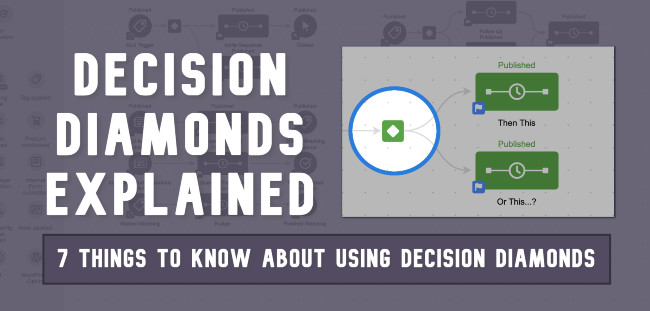
Decision Diamonds Explained

Decision Diamonds Explained

The campaign builder is the most popular part of Keap – and decision diamonds are a critical piece of what makes it so powerful.

In this blog post I’m going to answer some of the most common questions Keap (formerly Infusionsoft) users have about using decision diamonds in their campaigns.

Click on the link to jump to one of the specific questions:

If reading feels like a whole thing and you prefer the video version of this conversation then click here to jump to the video summary.

And if you find yourself wanting more information on decision diamonds, or the campaign builder in general, I recommend checking out this Campaign Builder 101 post, or hopping on the free trial of my CB Trilogy course.

Okay then – first up, what are they?

What are decision diamonds?

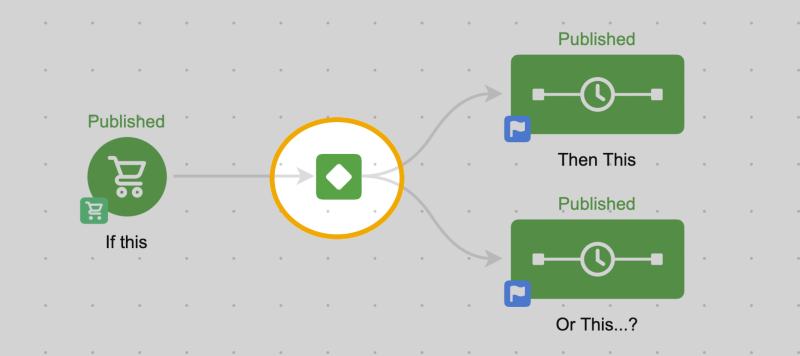
Well, simply put – decision diamonds are a node in the campaign builder that route contacts in different parts of your campaign.

Decision Diamond Spotlight

I think of it like the little ticket taker at one of those massive 24-theater Movie complexes. When a contact hits that point of the campaign, the decision diamond rips their ticket and points them in the right direction.

This brings us to the next question – why do they matter?

Why are decision diamonds valuable?

Decision diamonds are valuable for one simple reason – segmentation.

They allow us to treat different people differently, based on what we know about them.

This type of robust segmentation is really what helps Keap (formerly Infusionsoft) users create automation that doesn’t feel quite so….automated.

As you might know, the campaign builder works off of goals and sequences – which basically work out to “if this, then that” style logic.

If this goal is achieved, then add the contact to this sequence.

And you can totally build campaigns using this formula – goal, sequence, goal, sequence.

Campaign Builder 101 - Campaign Screenshot

(In fact, that’s absolutely how I recommend most people start – keep it simple when you can.)

However, it’s only a matter of time until you run into a scenario where you want different things to happen after a goal is achieved – based on any number of factors, and this is where decision diamonds come in.

They allow us to create different outcomes for the same action – so, two people fill out the same web form, but receive different follow up.

There are any number of reasons you might want to have different outcomes after an action – like, different behavior for people based on whether they’re a repeat buyer, or a new buyer; or different automation based on where they live in the world, or some other detail about themselves.

Which brings us to the next question – what information can I use?

What criteria is available for decision diamonds?

In general, decision diamonds can access contact information – which means field data, and tags.

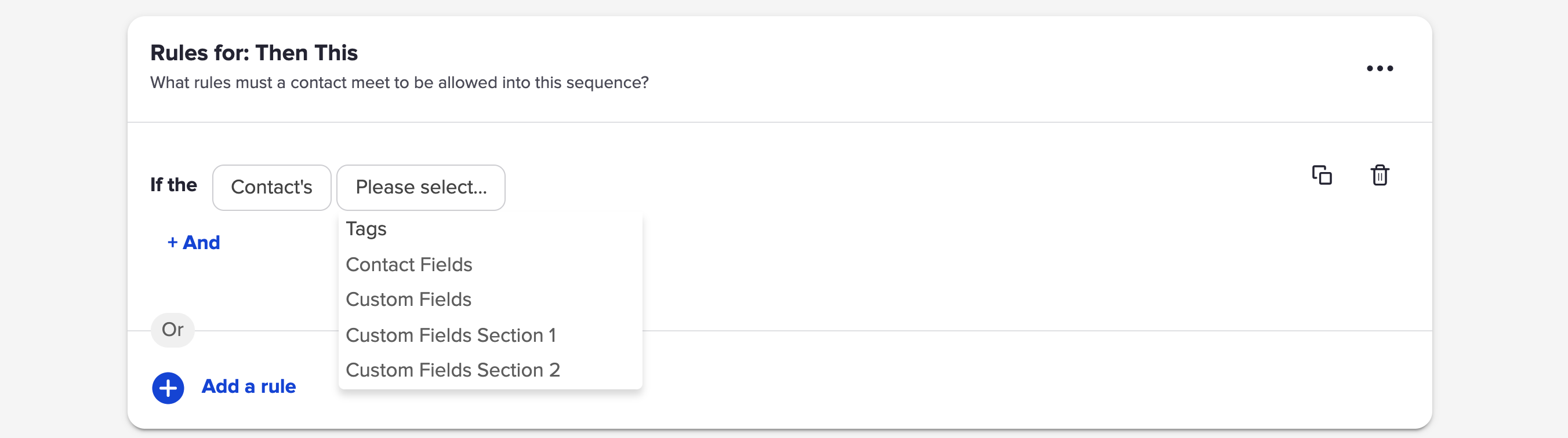
This might sound basic, but it opens up a lot of possibilities for us – because it means we can not only access their general contact details, like their city or state, or whether or not they have a phone number on file, but it also means we can check the value of any of the custom fields we’ve created.

Decision Diamond Rules

A simple use case would be if you ask a question on the opt-in, you can then tailor the automated response that is sent to match the answer that contact gave you as they were signing up.

This could mean using examples you know are relevant for that person – or even changing what product or service you recommend for them.

It’s worth pointing out that the options for building your rules change based on the type of field you’re using – so, if its a whole number field you can do greater than and less than, whereas if it’s a text field you’d do things like contains, or doesn’t contain.

Decision Diamond Field Types

In addition to the contact fields you can also use tags to create rules.

This makes decision diamond criteria infinitely more flexible, because tags can be applied automatically anytime someone takes an action. So, if you’re using the presence of tags to track behaviors – like, filling out a web form, clicking a link, or buying a product, then now you can use the contacts behavior (represented by tags) to route the contact into different sequences based on what they have or haven’t done.

And finally, decision diamonds can also access the data collected in a web form- meaning the selections a contact makes in radio options and checkboxes on Infusionsoft web forms and legacy landing pages.

This one is lesser known because this option really only shows up when a decision diamond is used immediately following the web form (or legacy landing page).

[Back to Top]

You might be thinking “man, these things are powerful – do they have any drawbacks?”

What limitations do decision diamonds have?

Decision diamonds have a few limitations – first, and most notably, at this point the rules you build are really only able to use information from the contact record itself.

That means you can’t use order details, opportunity details, or design rules using logic based off of the time of day, or the date.

My hope is that they’ll expand that over time (or soon would work too), and introduce some new flexibility that lets us segment contacts based on whether they used a promo code in their order, or if they’ve spent over $X with us over their lifetime, etc; but in the meantime we can create workarounds for most those scenarios using tools like Zapier, FixYourFunnel Bots, or PlusThis to copy information into custom fields, or to tags.

Another limitation for decision diamonds is that they can only use the information available at the time the contact hits that point in the campaign.

This isn’t so much a drawback as it is just something to be aware of – the decision diamond is a filter that assesses the contact using the rules you’ve created and then sorts it into one of the sequences options you’ve designed.

Like the Hogwarts Sorting Hat (I’m a ravenclaw, btw).

But if the contact’s information changes after they’ve been sorted, it doesn’t re-evaluate using the new info because the contact has now passed that point in the campaign.

Like I said – this isn’t necessarily a drawback – it’s just important to understand so you can build your campaigns to accommodate for that.

Alright – so you know the pros and cons, let’s talk about how to actually use it.

How do I add a decision diamond?

Decision diamonds are maybe the only element in Keap’s campaign builder that aren’t actually added by the user.

They don’t live on any of the menus – which can definitely be confusing at first, because it leaves users wondering “how do I add it…”

The answer is generally one of those facepalm moments: They show up when they’re needed.

(Kinda like the Room of Requirement, just to keep the Harry Potter references rolling.)

Decision diamonds appear when the campaign builder notices there are more than one possible outcome for an action, and it wants us (the user) to help it decide when to send people where.

Decision Diamond Poof

So if you have one goal leading to one sequence – no decision diamond needed.

It knows exactly what to do when that goal is achieved.

But if you have one goal leading to two (or more) sequences, then poof – the decision diamond pops in asking us to set up the rules that determine when they go where.

[Back to Top]

How do I configure the decision diamond rules?

Like any element in the Keap campaign builder, you’ll double click on the decision diamond when you want to configure it.

This takes you into the interface where you can design the rules for each sequence.

If you don’t design rules the default is that the contact will go into each of the available sequences – sometimes that’s okay, but normally you’ll want to set up rules so that they only go into the sequences that make the most sense for them.

Building the rules is kinda like creating a mad libs sentence – just follow the prompts.

Rule Building

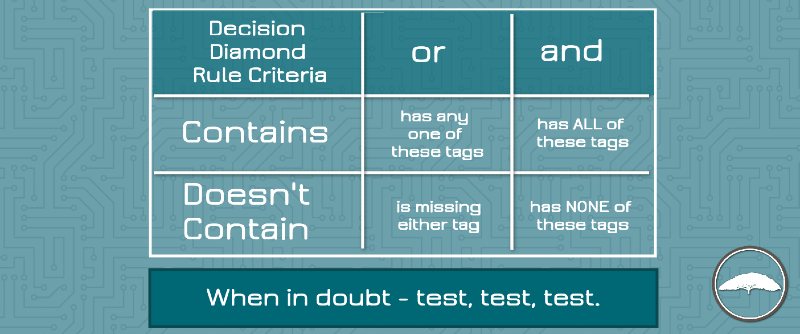
It uses boolean logic, which can get a little complex – so my advice is to try and keep your rules simple, and always always test your logic.

Here’s the cheat sheet I refer back to when in doubt.

Decision Diamond Cheat Sheet

Two things to look out for here:

  1. You can copy rules from one sequence to another, which can reduce the opportunity for human error when you’re creating multiple similar rules.
  2. You can also define a default outcome for people who don’t meet the criteria for any of your rules – choosing to let them drop out of the campaign, or, placing them in one of the sequences anyway.

Once you’ve set up your rules (and run a few tests), just go back to the campaign level. If the goal and sequences on either side of the diamond are set as ready then the diamond should be ready to publish too.

Here’s a little more documentation from the Keap help center.

And here’s a video from Box Out Marketing’s 12 Hacks of Christmas series where Tyler talks about testing decision diamonds.

[Back to Top]

The final question I’ll tackle in this post is one I’ve been hearing more and more lately.

Does Dynamic Content replace the need for decision diamonds?

Short answer: No.

Longer answer: Sometimes.

Dynamic Content, also known as Liquid Content, is a feature Keap quietly released at the start of 2020 – and it’s terrific.

You can read more about it here if you’d like, but basically it allows you to hide or show different parts of an email based on what you know about the recipient.

This type of advanced personalization is huge – and it absolutely reduces the need for decision diamonds (because we can do things like hide the CTA for someone who has already purchased).

But even with as flexible as dynamic content can be, it only changes the email content – not the overall experience.
So, decision diamonds are still the best bet for when you want to create two totally different sets of automation – like, sending a single email to some people and an entire email series to others.

Video Version

If you’re the type of person who likes your answers read to you aloud, then here’s a summary video answering all seven questions. Enjoy

Conclusion

Alright party people – I hope this has been useful and given you some more confidence for using decision diamonds throughout your Keap campaigns.

If you are interested in learning more about the campaign builder check out this Campaign Builder 101 blog post or this Campaign Builder Finishing School video series.

If you have any feedback, or specific questions about decision diamonds, drop a comment below. Thanks for reading.

Bonus Use Case

I believe that pretty much every campaign ever built could be improved through the use of a decision diamond – simply because adding segmentation means you’re able to personalize the experience you’re creating for people. Which is always a good thing.

Here’s a simple (and common) use case for how a decision diamond might fit:

5 Lessons I Learned Winning the Spartan World Championship

5 Lessons I Learned Winning the Spartan World Championship

Last weekend, I won the Spartan Trifecta World Championship.

I learned some stuff along the way that had nothing to do with running and lots to do with being a competitor, a leader, and a human.

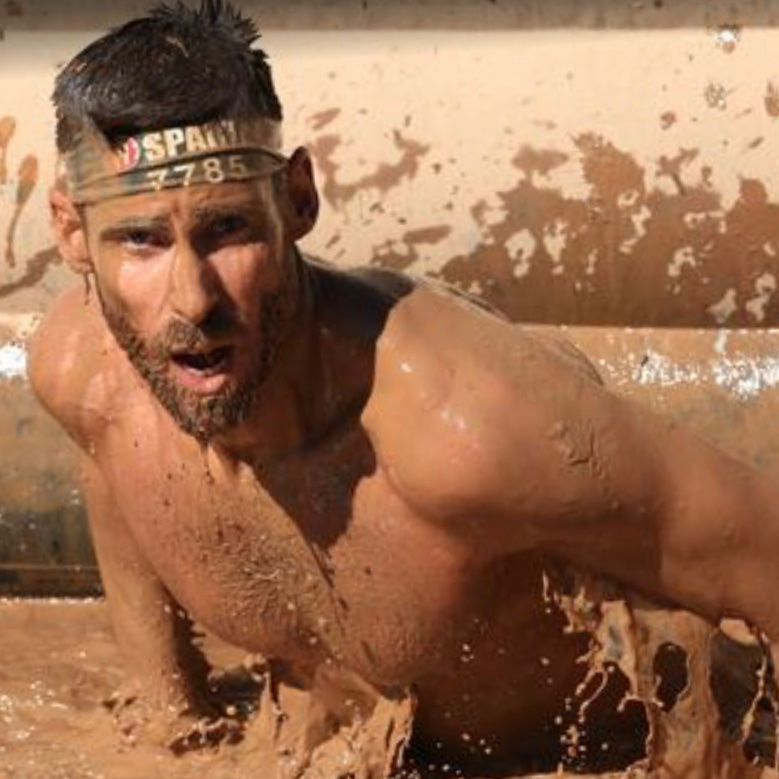
Spartan Jmac

Writing this blog post feels a little weird, braggy and personal, but I’m making myself get over it because I’m still learning and growing, and that’s worth sharing because we’re all on a similar journey to be our best version of us (and because Greg insisted I share this).

This post is about me, but it’s for you.

It’s not an Infusionsoft specific post, and the advice I’m offering isn’t uniquely applicable to small business – it’s advice for humans.

So if that doesn’t serve you, then permission granted to just pass this one by.

5 things I learned winning the Spartan Trifecta World Championship

  1. If you decide you’re going to do something, you can do it. (read it)
  2. Play to your unique superpowers. (read it)
  3. You’re only competing against yourself. (read it)
  4. You are made to do hard things. (read it)
  5. No one cares. And that’s okay. (read it)

First, the backstory:

Three years ago, I ruptured a disc in my lower back. I could barely walk, and I spent half a year sleeping on the floor in constant pain.

I was 37, and life as I knew it was over. It was depressing. And I learned lots of athletes go into deep depression and even alcohol and drug addiction to escape chronic pain .

It was serious. And it was scary because my identity started to get stripped from me. Athlete, coach, fun dad. I couldn’t run, I couldn’t throw, I couldn’t play with my kids.

And if you’ve ever experienced chronic pain or still do, I’m so sorry, and I know how hard that is. It’s a long road back, but it can be done.

So this injury was problematic for a few reasons, but one of them was a life goal I’d set for myself. When I was 20, I set a goal to be in better shape at 30, and then in better shape at 40 than 30, and finally, better shape at 50 than 40.

I’d accomplished the 30 year mark, and 40 was approaching. So I decided to work back and give myself a shot. I wasn’t cool with it being “over” at 37.

So I chose no pain killers, no surgery, just PT, diet, and patience.

I started running again in 2019. That first day back was a lap. Then a mile. Then a 5k.

With my body back, I set a goal to run the Spartan Trifecta by my 40th birthday.

The Spartan race is an endurance obstacle race, and the Trifecta is running all three of the race distances in the same year.

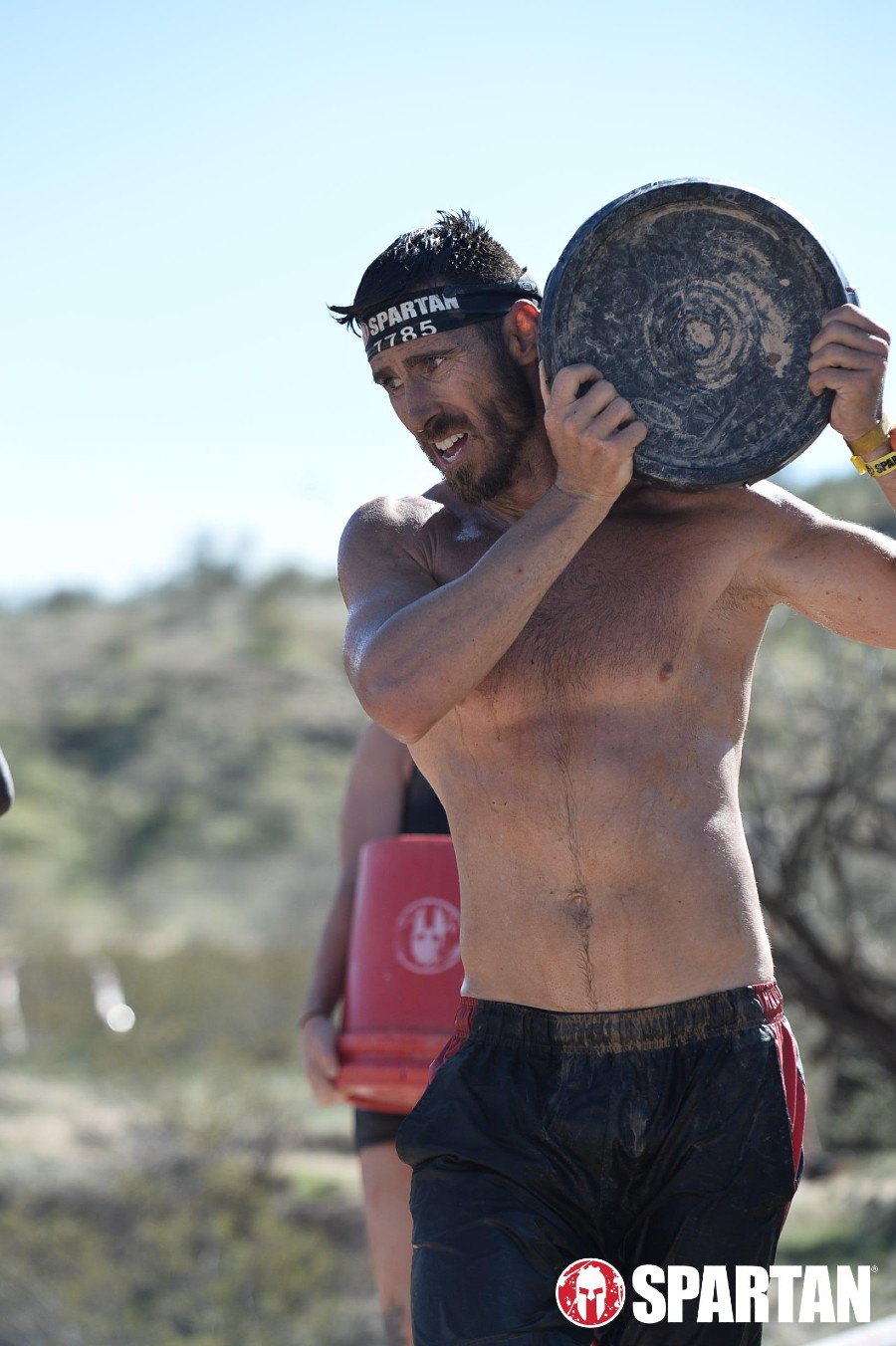
5k, 10k, half marathon, each with increasing number of crazy obstacles like Atlas stone carry, spear throwing, rope climbing, and bucket carries.

My first race was this February.

I placed first.

Then the COVID pandemic hit.

The world shut down, and I had to run my other races virtually.

But in the process, I accidentally qualified for the World Championships to be held in Sparta, Greece last weekend.

They had to run the race virtually, but now I really had no excuse. No air fare, no risk of travel.

But I would be racing in the Elite class with pros and serious racers. I don’t consider myself either.

What I accomplished over 8 months, I was now attempting to do in 48 hours, against professionals.

So that brings us to race weekend. And if you’re still reading, you want to know what those 5 things I learned are during that race.

Here they are:

1. If you decide you’re going to do something, you can do it.

There’s a difference between wanting to do something and deciding to do something.

wanted to be in better shape by 40, but it wasn’t until I decided, and then verbally declared it to others, that I had to change my behavior and make different choices to accomplish that thing.

I think the important lesson is also this: you can only decide to do something you can control.

I didn’t decide to win. I just decided to race.

So when you want something, stop wanting it and simply decide you’re going to achieve it, then do the things you must to achieve it.

This will separate you from 95% of everyone else on the planet.

2. Play to your unique superpowers.

You are the best at something. Find that thing, and ride it.

Don’t worry about the things you’re not great at. Just be acceptable at everything you need to be and really lean on that thing you’re truly great at.

For me, I found out a few things about myself as an athlete.

I was always a pretty good athlete. Better than average for sure.

But I’ve never been the best in the world at anything.

I’m not the fastest dude on the planet, or the strongest, nor the best long distance runner.

But, blend those three things, and I found out this combination of athleticism is perfectly suited to my strengths.

I’m stronger than the distance runners. I’m faster than the cross-fit dudes. And I’ve got better endurance than sprinters.

But there’s one more superpower that has helped me succeed in life and now in racing…

Grit.

I’ll outwork, outdig, outhurt, outsacrifice opponents.

Football is a game of inches. Racing is a game of seconds.

So often that inch or that second is a choice we can simply take and pay for with just a little suffering. The suffering is short-lived, but the victory is permanent in history.

So as you go about the game you play in life, small business, or whatever, find your sweet spots and work inside that as much as possible.

Use your superpowers. Maybe resilience. Maybe intelligence. Maybe intuition. Maybe toughness.

Just lean into it and ride it.

3. You’re only competing against yourself.

You already know this. But so often we get focused on others and what they are doing or what they are great at. Instead of just running our race, playing our game, being our best.

You are only as good as you are capable of being. No better.

So the best we can do in the moment is maximize our current capability. Don’t fight it, don’t wish it were better, just be as good as you can be at that moment.

If you want that capability to be greater, you have to go earn that with training. Investing in coaching. Actively working to upskill.

But in the moment, you are exactly who you are and capable of what you are capable of. Embrace that. Enjoy that. And achieve as much as you can in that moment.

When I was running I was thinking about the Eluid Kipchoge, the Kenyan who broke the 2 hour marathon this year. It’s insane what he did. Check it out when you can.

But basically, Kipchoge had to run a 5 1/2 minute mile for 26 miles.

Try to run a 5 1/2 minute mile for ONE mile…

So I ran my first mile of my first race at that pace…

Then guess what happened. I was gassed. My sprint race was my worst. I didn’t place first in that race. Because I was trying to be something I wasn’t. I was thinking about other people and wishing I could do something I wasn’t capable.

In the next two races, I simply ran. I didn’t think about anyone else. I just ran as well as I could. When I felt my pace slowing, I just pushed 1% more. Arm swing, knee drive, forward lean.

And I did something crazy, I stopped thinking about winning.

I just thought about running.

I had to remind myself that winning wasn’t why I was running. Winning wouldn’t change who I was. Winning wouldn’t make me better.

Winning was just a result.

Winning would be the result of whoever combined their preparation, athletic talent, and good running that day.

Which meant, I could only control one thing while in that race: how well I ran.

So I decided to just run my best. I decided to let go of fear and expectations I set on myself. And I decided to just run and enjoy the run for the sake of running, for the sake of getting up and doing what most people would never do.

That was winning.

4. You are made to do hard things.

Humans are biologically programmed to slay mammoths and saber toothed tigers.

Today we have to exchange real beasts for the beasts of our making. But it is for this that we are made.

I think we need to tap into this to live meaningful lives. There’s a reason humans are 28% less happy in the last 20 years, even though the world has never been wealthier, easier, or safer in human history.

You get to decide what hard things you want to slay. Can be physical. Can be mental. Can be emotional. Can be professional. Can be academic.

But make no mistake, you’re made to slay dragons.

5. No one cares. And that’s okay.

I really mean this.

Think about the pinnacle of your life so far. Think of the sacrifices you made to get there.

Now think about if it really matters. If anyone else cares, or even knows about it.

Think about the thing you care so much about, the things you’ve been obsessed with in life. Let’s say it’s winning a state championship (remember, I’m a football coach).

I’ve been obsessed with winning a state and national championship.

And I have, on multiple occasions. Felt awesome.

Did you know that? No. Do you care? no.

I suspect that’s true too for the awards and accolades in your field, industry, or region.

If we pursue excellence only for the satisfaction of others’ approval and adoration, we will be empty.

It doesn’t mean pursuing excellence isn’t worth it. It just means the pursuit of excellence IS excellence, and if that’s enough for us, we will be content. It also means there is no arrival.

The quest is the point.

Don’t collect trophies to validate your worth.

Just slay dragons because that’s what you do.

Conclusion

We really have only ONE thing we can control in our lives: what we choose to do with our time.

Our lives are the sum and product of those choices. Those choices are how we buy the life we want.

I hope your choice to read this helps you buy the life you want.

Keep Leading.

Keeping Contact Info Current

Keeping Contact Info Current

Call me old school, but I like to send a physical thank you card to anyone who buys one of my courses, or joins the OG membership.

(Don’t believe me? Try it.)

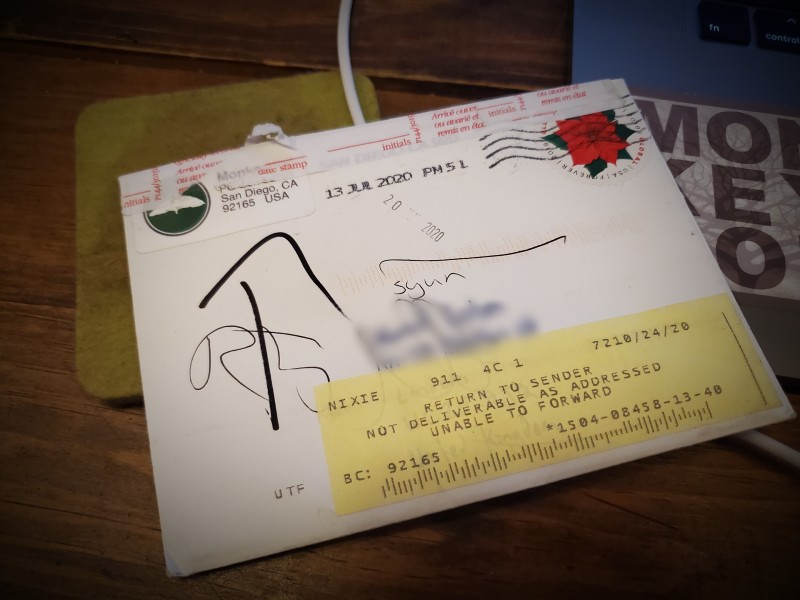
But, sometimes the address we use at checkout isn’t the same address where we receive mail, which means occasionally the thank you card is bounced back to me.

Return to Sender

And this doesn’t happen all that often, so in the past I’ve just dealt with it manually.

Normally I just send the recipient a quick email asking if there’s a better address I can use  – but last week I decided to build a simple automated process that handles this for me.

Campaign Structure

The following video breaks down the campaign above.

It reaches out to someone, and invites them to add information to their contact record – in my example it’s their shipping address I’m collecting, but this exact same structure could be used to collect any additional information about your contacts you might need (details about their business, about their goals, or details about them personally).

Check it out:

So, as you saw – this campaign is initiated by applying a note template, and then it reaches out the contact (multiple times if you like) asking them to add information to their contact record.

In my situation it was collecting the shipping address – but this same process could also be used to collect any other information you need, or to confirm information you already have on file, or adapted to let them review and update their email preferences.

If you’re curious about the FAQ campaign process I mentioned in the video – here’s an old video detailing the FAQ campaign set-up.

If you found this useful or have any questions about this process drop a comment below and let me know.